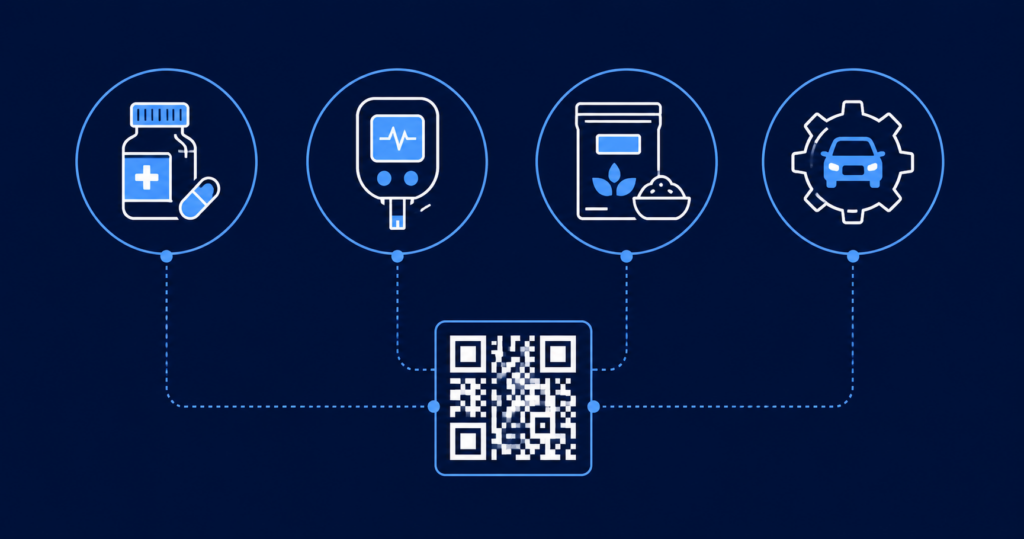
A practical breakdown of how GS1 Digital Link QR codes support real regulatory compliance in pharmaceuticals, medical devices, food, and automotive/aerospace, with the actual named regulations and deadlines behind each one.
- “Industry compliance” isn’t one rule; each regulated sector has its own law, its own deadline, and its own required GS1 Application Identifiers, covered by name below.
- Pharmaceuticals: the Drug Supply Chain Security Act (DSCSA) requires unit-level serialization with GTIN, lot, expiry, and serial number encoded in a GS1 DataMatrix (Pharmaceutical Commerce, 2026).
- Medical devices: the FDA’s Unique Device Identification rule (21 CFR Part 830) requires a machine-readable UDI on nearly every device label, with GS1 as one of three FDA-accredited issuing agencies (GS1, 2026).
- Food: FSMA Section 204 requires Traceability Lot Codes and Key Data Elements for high-risk foods, with a compliance date pushed to July 20, 2028 after Congress codified the extension (FDA, 2026).
- Automotive and aerospace: GS1 traceability isn’t a government mandate here, it’s driven by OEM and quality-standard requirements like IATF 16949 and AS9100 supplier traceability clauses (GS1, 2026).
- The common thread across all four: a correctly structured GS1 Application Identifier is what makes the data machine-readable and auditable, not the QR code itself.
- Getting the AI wrong doesn’t just create a bad scan, in regulated industries it can mean a rejected shipment, a failed audit, or a reportable compliance event.
- Need a QR strategy for the consumer-facing side of your packaging while your compliance team builds out full GS1 Digital Link? Start a free 14-day trial with OpenQR.
1. Why “Industry Compliance” Isn’t One Rule
Search for GS1 QR codes and industry compliance and you’ll find a lot of content that treats “compliance” as a single, generic concept: scan a code, get audit-ready, done. In practice, every regulated industry has its own law, its own agency, its own deadline, and its own required data elements. What counts as a compliant GS1 Digital Link QR code for a pharmaceutical distributor looks nothing like what counts as compliant for a food processor.
What they share is the underlying mechanism: a GS1 Application Identifier structures the data (GTIN, batch, serial number, expiry) so it means the same thing to every scanner, in every warehouse, in every country. The QR code or barcode is just the container. The compliance value comes from using the right AIs, in the right format, reported through the right channel.
2. Pharmaceuticals: DSCSA Serialization
The Drug Supply Chain Security Act (DSCSA) is the US federal law requiring electronic, package-level traceability for prescription drugs. Every saleable unit must carry a GS1 DataMatrix encoding four Application Identifiers: AI 01 (GTIN), AI 17 (expiration date), AI 10 (lot number), and AI 21 (unique serial number), printed at a minimum size of 5x5mm with ISO 15415 print quality grade B or higher (UPCGen, 2026).
Manufacturers and repackagers passed their deadline in May 2025, wholesale distributors in August 2025, and larger dispensers in November 2025. Small dispensers are the last group still under a time-limited exemption, and the FDA has said that date will not move again (MPI, 2026). The agency has already issued warning letters and criminal indictments for DSCSA violations (Drugzone, 2026), so this isn’t a theoretical compliance category. If your supply chain touches prescription pharmaceuticals in the US, the four core AIs above are non-negotiable, and they need to be readable by GS1 DataMatrix scanners at every handoff, not just at final retail.
3. Medical Devices: FDA UDI and EU MDR
Under 21 CFR Part 830, the FDA’s Unique Device Identification rule requires nearly every medical device to carry a UDI in two forms: a human-readable text string and a machine-readable barcode (AIDC). GS1 is one of three FDA-accredited issuing agencies, alongside HIBCC and ICCBBA, and GS1 standards often mandate GS1 DataMatrix specifically for the primary regulatory UDI on implants and surgical instruments (Uniqode, 2026). Device UDIs must also be submitted to the FDA’s Global Unique Device Identification Database (GUDID).
The EU runs a parallel system under Regulation (EU) 2017/745 (MDR). As of May 28, 2026, new MDR and IVDR devices must be registered in EUDAMED, the EU’s device database, before the first unit is placed on the market, per Commission Decision (EU) 2025/2371 (InformaIT, 2026). Manufacturers selling into both the US and EU are increasingly designing a single “global pack” label that satisfies both systems at once, since maintaining two separate label designs per device is operationally expensive.
4. Food: FSMA 204 Traceability
Section 204 of the Food Safety Modernization Act requires businesses handling foods on the FDA’s Food Traceability List (including shell eggs, soft cheeses, leafy greens, and ready-to-eat deli salads) to maintain enhanced records: a written Traceability Plan, Traceability Lot Codes (TLCs), and Key Data Elements (KDEs) captured at each Critical Tracking Event (CTE), producible to the FDA within 24 hours of a request (Reliamag, 2026).
The original compliance date of January 20, 2026 was pushed back 30 months to July 20, 2028, following an FDA proposal in March 2025 that Congress later codified through the Continuing Appropriations Act of 2026 (Inecta, 2026). That extension is real, but it isn’t a reason to pause. Several major retailers are enforcing supplier traceability requirements ahead of the federal date. Walmart’s supplier traceability requirement, including ASN with KDE data, SSCC-18 pallet labels, and GS1-128 case labels, took effect August 1, 2025, with chargebacks already being assessed for non-compliant shipments (Inecta, 2026). For suppliers selling into large retail, the retailer’s date is often the one that actually matters operationally.
5. Automotive and Aerospace: OEM-Driven Traceability
Unlike pharma, medical devices, and food, GS1 traceability in automotive and aerospace isn’t driven by a single government law. It’s driven by quality management standards and OEM supplier requirements. IATF 16949 (automotive) and AS9100 (aerospace) both build traceability and product safety directly into their core quality clauses, and suppliers who can’t demonstrate part-level traceability risk losing OEM contracts, not facing a government fine (Quality Magazine, 2026).
GS1’s role here is the Global Traceability Standard (GTS2), which defines Critical Tracking Events and Key Data Elements at three levels of identification: class-level (product/part ID), batch/lot-level, and instance-level (fully serialized) (GS1, 2026). Companies like the French national railway SNCF, L’Oréal, and Decathlon have adopted GS1 standards for parts and product traceability outside of any specific legal mandate, largely because it interoperates cleanly across suppliers, countries, and quality audit systems (Gravotech, 2026). If you’re a Tier 1 or Tier 2 supplier, the practical driver to check is your specific OEM’s supplier quality manual, not a federal register.
6. Common Mistakes That Break Compliance
FAQ
Does a GS1 QR code automatically make my product compliant?
No. Compliance depends on which Application Identifiers are encoded, how the data is formatted, and in some industries, whether that data is also submitted to a government database like GUDID or EUDAMED. The QR code is the delivery mechanism, not the compliance itself.
Which industries currently have hard regulatory deadlines for GS1 traceability?
Pharmaceuticals (DSCSA, full enforcement May 28, 2026, small dispensers November 27, 2026), medical devices (FDA UDI, ongoing, plus EU EUDAMED registration from May 28, 2026), and food (FSMA 204, compliance date July 20, 2028) all have specific government deadlines. Automotive and aerospace traceability is driven by industry quality standards and OEM contracts rather than a single law.
What’s the difference between DSCSA and FDA UDI?
DSCSA covers prescription drug packages and requires serialization plus electronic transaction data exchange between trading partners. FDA UDI covers medical devices and requires a unique device identifier on the label plus registration in the GUDID database. They’re separate rules covering separate product categories, though both rely on GS1 Application Identifiers and both can use GS1 DataMatrix as the data carrier.
Is FSMA 204 compliance still required if the deadline moved to 2028?
Yes. The FDA has been explicit that the rule itself is unchanged, only the enforcement date moved. Major retailers are also enforcing their own supplier traceability requirements ahead of the federal deadline, so many suppliers face an earlier practical deadline than the federal one.
Do automotive and aerospace suppliers need to comply with a specific law?
Not typically a government law in the way pharma or food do. The pressure comes from quality management standards like IATF 16949 and AS9100 and from individual OEM supplier requirements, which increasingly specify GS1-based part traceability as a condition of doing business.
Where do I find the exact GS1 Application Identifiers required for my industry?
Start with our full GS1 Application Identifier list for the general reference, then check your specific regulatory guidance (FDA, GS1 Healthcare US, or your OEM’s supplier manual) for the exact required subset, since requirements vary by product category and region.