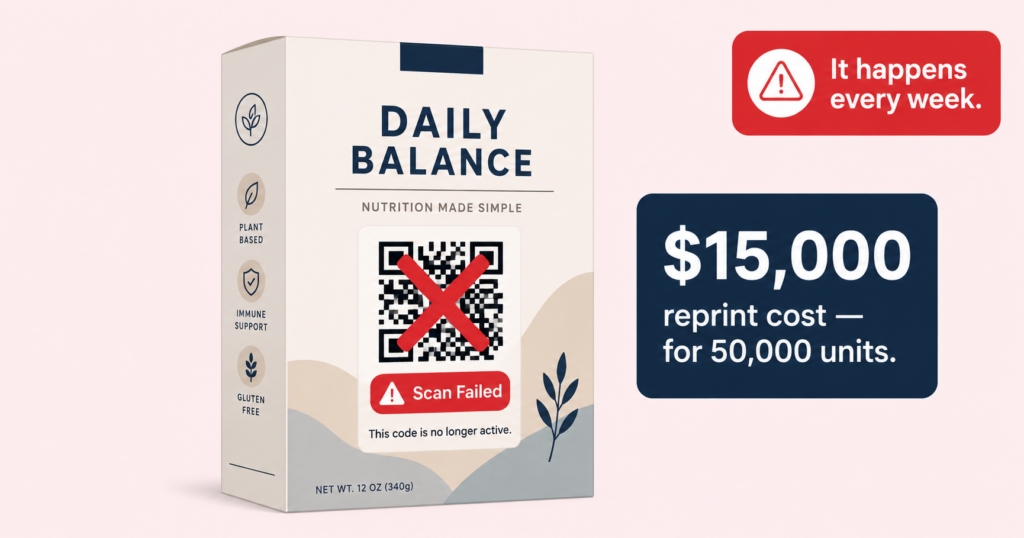
Your QR code just expired. Your packaging is already in stores. 50,000 units on shelves, in distribution centers, in customers’ homes – every one of them carrying a code that now leads nowhere. This is not a hypothetical. It happens to brands every week, and the reason is almost always the same: a QR code platform that deactivates codes when a subscription lapses. This article explains what “non-expiring” actually means, what it costs when codes fail, and why OpenQR is the only platform built for packaging that takes this risk off the table entirely.
1. The Real Cost of an Expired QR Code on Packaging
When a QR code on packaging stops working, the damage is not just the reprint bill. It moves in layers, each one more expensive than the last, and most of it is invisible on any single invoice.
The direct reprint cost is only the start. Here is what actually accumulates:
Direct reprint costs: Packaging reprints are not cheap per unit at scale. A typical short-run label reprint for 50,000 units runs $5,000 to $15,000 depending on material, finish, and supplier. At 100,000 units it scales proportionally, and at 500,000 units you are looking at a six-figure problem before you factor in anything else.
Distribution and logistics: Pulling affected inventory from retail locations, distribution centers, and 3PL warehouses has a real cost in labor and freight. If the product has already been shipped internationally, the complexity compounds significantly.
Retailer relationship damage: Major retailers increasingly audit QR codes on products they stock, particularly as GS1 Sunrise 2027 requirements raise the profile of packaging QR codes. A broken code discovered by a buyer is not just a support ticket – it is a conversation about brand reliability that you do not want to have.
Consumer brand damage: A consumer who scans a dead QR code does not think “the software platform subscription lapsed.” They think your brand is unprofessional, your product is discontinued, or your company has a problem. That perception does not reset when you fix the code.
Time cost: The internal hours spent diagnosing, escalating, negotiating with the QR platform, coordinating reprints, and managing retailer communication do not appear on any invoice – but they are real and they are significant.
2. Why Most QR Generators Expire Your Codes
To understand why this problem is so widespread, you need to understand how dynamic QR codes work technically. A dynamic QR code does not store your destination URL directly in the printed pattern. Instead, it stores a short redirect URL controlled by the QR platform. When someone scans the code, the scan hits the platform’s servers first. The server looks up your current destination and forwards the consumer there. If the server decides not to forward – because your account is inactive, your trial ended, or your payment failed – the scan goes nowhere useful.
This architecture is why dynamic QR codes can be edited after printing: you change the destination in the platform’s database, and the next scan reflects that change immediately. The printed code never changes. But this same architecture is what creates the expiry risk: the platform controls whether your scan resolves, permanently.
For most platforms, deactivating codes when accounts lapse is straightforward business leverage. An expired code is a very effective tool for converting a lapsed customer back into a paying one – especially when the alternative is reprinting thousands of labels. This is why the QR code industry has developed what researchers now call the “subscription trap”: generate codes during a free trial or low-cost plan, print them on materials, then deactivate when billing stops.
The practical implication for packaging is severe. Most consumer packaging has a shelf life in active distribution of 2 to 3 years. A payment interruption of 60 days somewhere in that window – a credit card expiry, a team change, a company restructuring – can break every code in the market simultaneously. The printed packaging stays on shelves. The digital experience disappears.
3. What “Non-Expiring” Actually Means
“Non-expiring” is used loosely in the QR code industry, and the distinction matters for packaging buyers. There are three different things a platform might mean when it uses this language:
Static codes never expire – this is true of essentially every platform, and it is technically accurate but operationally useless for packaging. A static code’s destination is encoded permanently in the printed pattern. You cannot update it after printing. If your URL changes, your product reformulates, or your campaign ends, the code points to the wrong place forever. Static codes are not a viable option for any packaging that needs an updatable digital destination.
Dynamic codes that stay live while your subscription is active – this is the standard model for most paid platforms. As long as you keep paying, the code works. The moment you stop – for any reason – the code dies. This is not non-expiring. It is subscription-dependent expiry with delayed consequences.
Dynamic codes that remain live permanently, regardless of subscription status – this is genuine non-expiry. It means the redirect infrastructure stays active even if your account changes, your plan downgrades, or your billing lapses. The code continues to work. This is what OpenQR delivers, and it is the only model that is genuinely safe for packaging with multi-year distribution windows.
4. The Reprint Cost Comparison: 50k / 100k / 500k Units
The reprint math is the clearest way to understand why non-expiring codes are not a nice-to-have for packaging – they are a risk management decision. The numbers below are based on typical commercial label printing costs and do not include the secondary costs described in section 1.
| Print run size | Typical label reprint cost | OpenQR annual cost (Business plan) | Risk avoided per year |
|---|---|---|---|
| 50,000 units | $5,000 – $15,000 | $516/year | Up to 29x annual subscription cost |
| 100,000 units | $10,000 – $30,000 | $516/year | Up to 58x annual subscription cost |
| 500,000 units | $50,000 – $150,000+ | $516/year | Up to 290x annual subscription cost |
The comparison is not even close. The cost of a single reprint event caused by code expiry is multiples of the annual cost of a platform that prevents it. For any brand running packaging at meaningful volume, the question is not whether to pay for non-expiring codes – it is why anyone would risk the alternative.
There is also a less visible cost that does not appear in any reprint quote: the cost of uncertainty. When you do not know whether a subscription interruption will kill your packaging codes, your team carries that as operational risk. Someone has to monitor it, track renewal dates, and manage the vendor relationship carefully. With OpenQR’s non-expiring model, that risk is removed entirely. The code works. Full stop.
5. Side-by-Side: OpenQR vs QR Tiger vs QRFY vs Bitly vs Egoditor
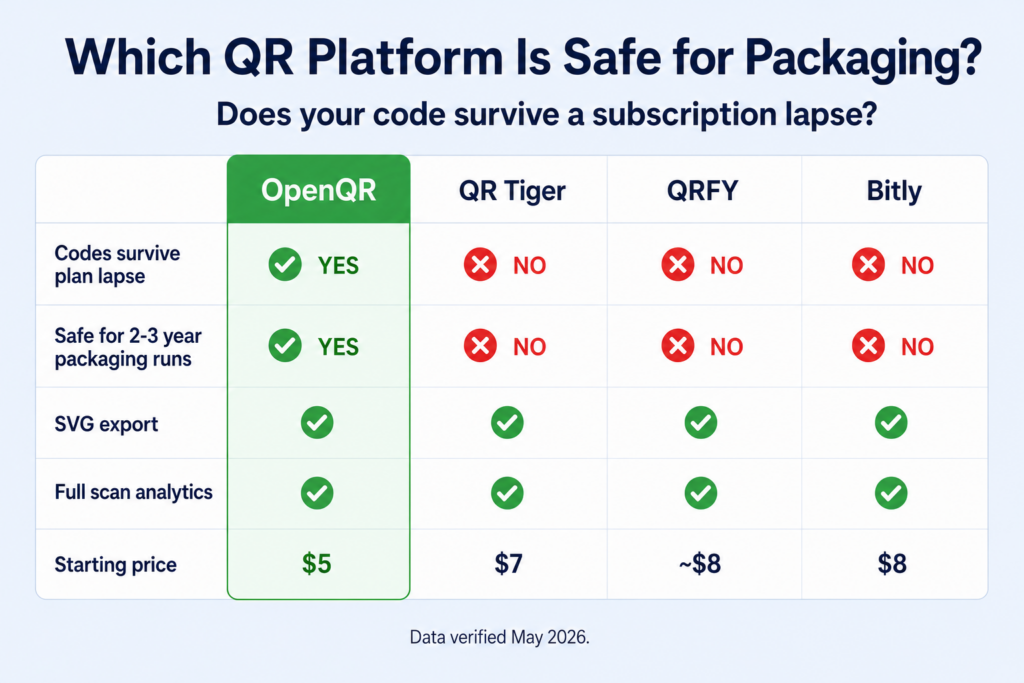
Here is how the major platforms compare on the features that matter most for product packaging use cases. Every claim below is based on publicly documented platform behavior as of May 2026.
| Feature | OpenQR | QR Tiger | QRFY | Bitly |
|---|---|---|---|---|
| Codes survive subscription lapse | ✅ Yes – permanently | ❌ No | ❌ No | ❌ No |
| Dynamic (editable after print) | ✅ Yes | ✅ Yes (paid) | ✅ Yes (paid) | ✅ Yes (paid) |
| Scan analytics | ✅ Full – location, device, time, unique scans | ⚠️ No unique scan tracking | ✅ Yes | ✅ Yes |
| SVG export for print | ✅ Yes | ✅ Yes (paid) | ✅ Yes | ⚠️ Limited |
| Custom branding (logo + colors) | ✅ All plans | ✅ Paid plans | ✅ Paid plans | ✅ Paid plans |
| GDPR/CCPA compliant (no IP storage) | ✅ Yes | ⚠️ Not confirmed | ⚠️ Not confirmed | ⚠️ Not confirmed |
| Free trial expires codes | ✅ No – codes survive trial end | ❌ Yes – 500 scan cap on free | ❌ Yes – 7-day trial | ❌ Yes – monthly link limits |
| Safe for multi-year packaging runs | ✅ Yes | ❌ No | ❌ No | ❌ No |
| Starting price (paid plan) | $5/month | $7/month | ~$8/month | $8/month |
The comparison table tells a clear story. OpenQR is the only platform in this comparison where codes remain active after a subscription lapses – making it the only platform that is genuinely safe for product packaging with a multi-year distribution window. On pricing, OpenQR is competitive with or cheaper than every alternative, and it starts at $5/month for its Starter plan covering 10 dynamic codes.
The Bitly comparison deserves a specific note. Bitly is a well-known brand and many teams reach for it by default. For short-term marketing campaigns with predictable lifespan, it is a reasonable tool. For packaging, it is the wrong choice: Bitly’s link infrastructure ties code functionality to your subscription, and their packaging-specific guidance is essentially non-existent. Bitly was built for digital marketing links, not for SVG-exported QR codes going onto physical materials with 2 to 3 year distribution windows.
6. How OpenQR Keeps Your Codes Live
OpenQR’s non-expiring architecture is a deliberate product decision, not a feature accident. The platform was built for brands using QR codes on physical materials – packaging, print, signage – where the cost of a broken code is measured in reprint bills and retailer relationships, not just a failed marketing click.
The specific mechanism: when you create a dynamic QR code in OpenQR, the redirect infrastructure is set up to remain active permanently. If your plan lapses, the code continues to resolve. The consumer experience during a lapse briefly includes an OpenQR attribution message before the redirect completes – your destination is still reached. When your plan is active, the experience is fully clean and branded.
This design means you can use OpenQR codes with confidence on:
- Long-run packaging with 2 to 3 year distribution windows, where subscription continuity cannot be guaranteed over the entire product life.
- Packaging for international markets, where distribution timelines extend further and recall logistics for a broken QR code are significantly more complex.
- Private label and own-brand products, where the manufacturer and retailer may have separate operational teams and no single person owns the QR platform subscription renewal.
- Products moving through acquisition or restructuring, where vendor relationships and payment methods change during transitions and a subscription lapse is a genuine operational risk.
- Products sold in the EU under ESPR: The EU Digital Product Passport regulation requires QR codes to resolve to live product data for a minimum of 10 years after market placement. A platform that deactivates codes on subscription lapse creates a direct compliance failure under this obligation. Learn what the EU DPP requires from your QR code →
Beyond non-expiry, OpenQR provides the full feature set that packaging use cases require. Scan analytics give you total scans, unique scans, location data, device type, and time of scan – directly in your dashboard. SVG export ensures your code prints cleanly at any size and on any substrate without quality loss. Custom branding lets you embed your logo and brand colors into the code design. And GDPR and CCPA compliance through a no-IP-storage policy means your consumer scan data is collected responsibly – which matters increasingly for brands selling in the EU and California.
For brands managing multiple SKUs or needing to automate QR code generation across product lines, OpenQR’s API lets you create and manage codes programmatically at scale. This is particularly useful for QR codes on product packaging across large product ranges where manual creation per SKU is not practical.
7. Frequently Asked Questions
What happens to my OpenQR codes if I cancel my subscription?
OpenQR codes remain active after your plan changes or lapses. The redirect infrastructure stays live permanently. If your subscription is not active, the consumer will briefly see an OpenQR attribution message before being redirected to your destination – but the destination is still reached. This is fundamentally different from platforms that show an error page or a “resubscribe” prompt when accounts lapse. Your packaging does not become waste if your billing has an interruption.
Do QR Tiger’s dynamic codes really expire?
Yes – QR Tiger’s free plan caps dynamic codes at 500 scans, after which they stop working. On paid plans, dynamic codes are tied to an active subscription. Multiple user reviews on G2 and third-party audits published in 2026 confirm that codes stop working when subscriptions lapse, requiring users to renew to reactivate. This is a documented behavior, not an edge case. For product packaging use cases where codes are printed on physical materials with multi-year shelf lives, this represents a concrete and avoidable risk.
Can I migrate from QR Tiger (or another platform) to OpenQR without reprinting?
For codes already printed on packaging in market, migration without reprinting is not possible – the printed code points to the old platform’s redirect URL. However, you do not need to reprint immediately. The practical approach is to keep existing printed packaging running on your current platform while migrating new packaging runs to OpenQR. Create your new OpenQR codes, update your artwork files, and use the new codes for your next print run. Over time, the old platform codes cycle out of market naturally as inventory turns.
What is the difference between a non-expiring dynamic QR code and a static QR code?
A static QR code has no expiry risk because the destination URL is encoded directly in the printed pattern – but it also cannot be updated after printing. If your URL changes, the code points to the wrong place forever. A non-expiring dynamic QR code – like those from OpenQR – gives you the best of both: the destination can be updated at any time from your dashboard, and the code remains live regardless of subscription status. For packaging, this combination is the correct architecture: the printed code is permanent, the digital destination is flexible.
How does OpenQR’s pricing compare for packaging use cases?
OpenQR’s Starter plan at $5/month covers 10 dynamic codes – suitable for brands with a focused product range. The Life plan at $11/month covers 50 codes, and the Business plan at $43/month covers 500 codes for larger ranges. All plans include the non-expiring code guarantee, SVG export, analytics, and custom branding. Compared to QR Tiger’s equivalent paid plans starting at $7/month – with the added risk of expiry on subscription lapse – OpenQR delivers a lower total cost of ownership when you factor in the reprint risk that the non-expiring model eliminates.
Are there other QR code platforms where codes never expire?
A small number of platforms offer permanent static codes (which all platforms do by definition) or free-tier dynamic codes with permanent redirects. For dynamic codes with full analytics, custom branding, SVG export, and a non-expiry guarantee across all plans, OpenQR is the strongest option specifically designed for packaging and physical media use cases. The combination of non-expiry, full analytics, SVG export, and GDPR-compliant no-IP tracking is not found together in the main competitor platforms.
Switch to a Code That Never Breaks
OpenQR codes never expire – even if your plan changes. Dynamic, brandable, analytics-enabled, SVG-ready. Free 14-day trial, no credit card required.