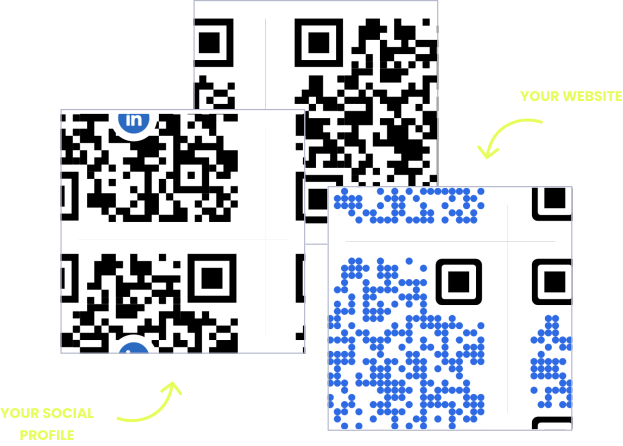
WITHOUT OPENQR
- Reprint the whole batch every time a link or guide changes
- No way to know how many buyers actually scanned the code
- Generic codes with no logo, color, or brand identity
- Code breaks if you switch platforms or hosting
WITH OPENQR
- Update the destination live – no reprint, no wasted stock
- Track every scan by product, location, and device
- Fully branded with your logo, colors, and fonts
- Codes never break, even if your plan changes
Packaging deserves a smarter QR code
A QR code on a printed label is permanent the moment it ships. If it points to a static link, that link is locked in for the entire life of the print run – and packaging print runs are not small. A formulation changes, a how-to video gets replaced, a promotion ends, and every unit already on a shelf or in a warehouse carries a dead or wrong code. There is no fixing it without a reprint.
A dynamic QR code from OpenQR points to a destination you control, not a link baked into the pattern. Change the how-to guide, update the nutrition PDF, or swap a launch page for a reorder page, and every unit in the market redirects instantly – the code on the box never changes. And because every scan is tracked, you know which products, regions, and production batches are actually getting scanned.
HOW BRANDS USE OPENQR ON PACKAGING
One code. Endless ways to use it.
Pick the right QR type for the job – every one is dynamic, trackable, and editable long after it is printed.
How-to guides and usage tips that stay current
Link the code to a how-to video, care instructions, or a getting-started guide you can update anytime. Fix a step, add a new tip, or swap the guide entirely without touching a single unit already on the shelf.
USES: PDF QR CODENutrition facts and ingredient transparency
Host the full nutrition panel, allergen list, or sourcing story online instead of cramming it onto a shrinking label. Update it the moment a formulation changes, and every unit in the market reflects it.
USES: URL QR CODEProduct manuals without the paper insert
Skip the multi-language paper booklet. Point the code at a hosted PDF manual or setup guide, and update it the moment a spec, safety note, or model number changes.
USES: PDF QR CODERedirect straight to your product page or promotion
Send buyers to the exact product listing, a limited-time offer, or a reorder page. Change the destination for every launch, season, or campaign without reprinting a single box.
USES: URL QR CODEWarranty registration and authenticity in one scan
A code inside the box opens your warranty form or an authenticity check. Update the destination anytime, and registration data lands straight in your dashboard.
USES: URL QR CODEThree tips for packaging that get scans
Skip the curve and the gloss
Print codes on a flat, matte panel wherever possible. Curved bottles, foil finishes, and glossy laminate all distort the pattern or cause glare – test a physical proof on the real material before the full run.
Give the QR code a job in the label copy
“Scan for setup instructions” or “Scan to register your warranty” next to the code drives far more scans than a bare square with no explanation.
Size for shelf distance, not screen distance
Use the 10:1 rule: code width in cm should equal expected scanning distance in cm divided by 10. A code meant to be scanned from arm’s length needs at least 2 x 2 cm.
Built for packaging that ships in volume
PDF manual & how-to hosting
Upload a manual, how-to guide, or spec sheet and OpenQR serves it to every buyer. No website, no developer, no separate hosting bill.
Swap the destination per season or SKU
Point one printed code at a launch page today and a reorder or promotion page next quarter. The code on the box never changes – only what it leads to.
Scan analytics by product and batch
See which SKUs, regions, and production runs actually get scanned. GDPR and CCPA compliant, no IP addresses stored.
One page for manual, warranty, and reorder
The landing page builder puts your manual, warranty form, and reorder link behind a single code on the box.
QR solutions brands use most for packaging
How OpenQr helps you
Boost engagement and insights through dynamic, customizable QR codes.

Track every scan and optimize smarter
Know exactly when, where, and how your QR Codes are scanned. See device types, locations, and scan frequency – and use data to improve your campaigns and boost ROI.
Read more
Make every QR code uniquely yours
Customize your QR Codes with brand colors, logos, call-to-action text, and even creative frames or edges. Stand out, stay on-brand, and drive more engagement from every scan.
Read more
Update links anytime – even after printing
Dynamic QR codes let you change your URL or content at any time without needing to reprint. Perfect for updated how-to guides, revised nutrition facts, or fixing a link before the next production run.
Read moreNo credit card required
What a QR code system replaces on product packaging
Packaging QR codes are mainstream, not experimental – 49% of US consumers have already scanned a QR code on a food or beverage package (Statista, 2024). What makes packaging different from most other QR placements is how often the linked content needs to change even when the box itself does not: a how-to video gets re-shot, a nutrition panel updates with a reformulation, a promotion ends, a warranty process changes. Static print cannot follow any of that. A dynamic code can.
The economics follow the same logic as any other print asset. Every content change on a static code means a reprint – design time, packaging cost, and the old units either recalled or left circulating with dead links. With a dynamic QR code the printed panel is permanent and only the destination changes, so the reprint line in your packaging budget approaches zero. You can work through your own numbers in the free vs paid QR generator guide.
Warranty and authenticity are where this pays for itself fastest. US manufacturers paid $30.37 billion in warranty claims in 2025, up 4% from the year before (Warranty Week, 2025), and most of that process still runs on paper cards buyers never mail in. A QR code that opens a pre-filled registration form at unboxing – the moment the buyer is most engaged – replaces that paper process entirely, and the same serialized code can double as an authenticity check for higher-value goods.
Regulation is the other reason to get this right now rather than at the next redesign. GS1 Sunrise 2027 is pushing major retailers toward accepting 2D barcodes at checkout, and the EU Digital Product Passport will require certain product categories to carry structured lifecycle and sustainability data accessible by QR. Both are built to run on the same kind of dynamic, updatable code covered on this page – see the full breakdown in our GS1 Sunrise 2027 guide and our EU Digital Product Passport guide. Start with the buyer-facing use case that matters most to your product today, and the compliance layer builds on the same foundation.
49% of US consumers have scanned a QR code on food or beverage packaging (Statista, 2024).
The printed code is permanent. How-to, nutrition, and manual updates happen in the dashboard, not at the printer.
US manufacturers paid $30.37 billion in warranty claims in 2025, up 4% from 2024 (Warranty Week, 2025).
GS1 Sunrise 2027 and the EU Digital Product Passport both run on QR, not barcodes alone.