QR codes were scanned over 26 billion times in 2023 – and adoption has grown every year since. But the brands driving those scans are not placing codes randomly on flyers and hoping for the best. They are running QR codes as a deliberate, trackable marketing channel with clear goals, purpose-built landing pages, and monthly analytics reviews.
The difference between a QR code that generates real business results and one that collects dust on a leaflet is not the code itself. It is the strategy behind it: what the code promises, where it appears, what happens after the scan, and how the data gets used to improve the next campaign.
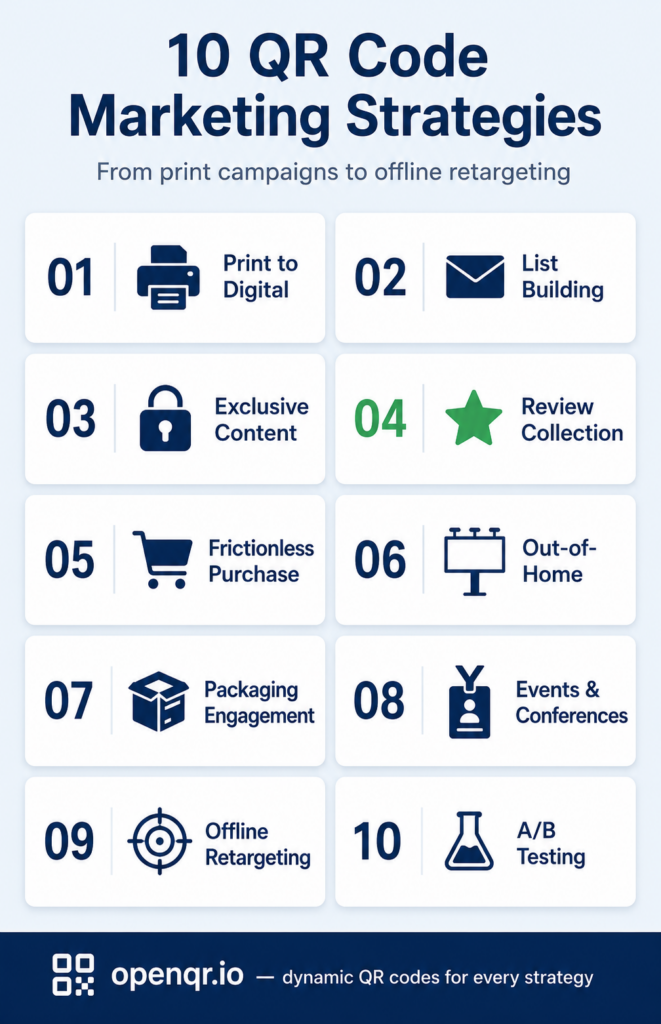
This guide covers the complete QR code marketing strategy framework – from the foundational principles every campaign needs through to 10 proven strategies used by brands across retail, hospitality, events, and B2B, plus how to measure performance and compound improvements over time.
- 89 million US smartphone users scanned a QR code in 2022 – a number that has grown every year since (Statista, 2023). Scanning is now instinctive for most adults.
- Always use a dynamic QR code for any marketing campaign. Dynamic codes are trackable, updatable, and give you the analytics you need to improve results.
- One goal per code, one action per landing page. QR codes pointed at a homepage underperform every time. Match the destination exactly to what the CTA promised.
- Codes with a specific, contextual CTA receive up to 80% more scans than codes displayed without explanatory text.
- The post-scan mobile experience – page speed, single CTA, mobile layout – is where most campaigns win or lose. A 1-second load delay reduces conversions by approximately 7% (Google).
- Dynamic codes let you track every scan by location, device, and time – bringing digital-style attribution to offline marketing for the first time.
- Why QR Codes Are a Serious Marketing Channel in 2026
- Foundation: Dynamic Codes, One Goal, One Action
- Strategy 1: Drive Traffic from Print to Digital
- Strategy 2: Build Email and SMS Lists from Physical Locations
- Strategy 3: Deliver Exclusive Content and Gated Offers
- Strategy 4: Collect Reviews at the Moment of Satisfaction
- Strategy 5: Enable Frictionless Product Purchases
- Strategy 6: Run Measurable Out-of-Home Campaigns
- Strategy 7: Enhance Packaging with Post-Purchase Engagement
- Strategy 8: Personalise Events and Conference Experiences
- Strategy 9: Retarget Offline Audiences Online
- Strategy 10: A/B Test Physical Marketing Materials
- The Post-Scan Experience: Where Most Campaigns Win or Lose
- Measuring QR Code Marketing Performance
- 7 QR Code Marketing Mistakes to Avoid
- Frequently Asked Questions
Why QR Codes Are a Serious Marketing Channel in 2026
QR code adoption crossed a cultural threshold during 2020–2022 when contactless interactions became the default in restaurants, retail, and events. What changed permanently was consumer behaviour: scanning a QR code with a phone camera is now instinctive for most adults in developed markets – it requires no app, no training, and no friction.
According to Statista, 89 million US smartphone users scanned a QR code in 2022. A 2023 MobileIron survey found that 86% of smartphone users had scanned a QR code at least once in the previous year. In the UK, QR usage nearly doubled between 2019 and 2023.
What makes QR codes particularly valuable as a marketing channel in 2026 is a combination of three factors that few other channels offer simultaneously:
- Physical-digital bridge – QR codes connect offline assets (print, packaging, signage) to online conversion flows that would otherwise be unreachable from a physical surface.
- Zero incremental reach cost – Once printed, every scan is free. Unlike paid digital ads, cost does not scale with impressions or clicks.
- Attribution in physical channels – Dynamic QR codes bring digital-style tracking to offline marketing, letting you measure the ROI of a flyer, poster, or product label with the same precision as a Google Ads campaign.
💡 The opportunity: Most competitors are printing QR codes on marketing materials as an afterthought – a static code pointing to a homepage. The brands winning with QR code marketing use dynamic codes, purpose-built landing pages, and analytics to run offline marketing as rigorously as any digital channel.
Foundation: Dynamic Codes, One Goal, One Action
Before covering specific strategies, three foundational principles apply to every QR code marketing campaign. Getting these right separates campaigns that produce measurable results from those that generate vague activity with no clear outcome.
Always use dynamic QR codes for marketing
A static QR code encodes its destination URL directly into the code pattern. Once printed, the destination cannot be changed and the code produces zero analytics – no scan count, no location data, no device breakdown. A dynamic QR code redirects through a short URL you control. This gives you three critical capabilities: update the destination without reprinting, track every scan in real time, and run split tests by sending traffic to different landing pages from the same physical code.
One goal per code, one action per landing page
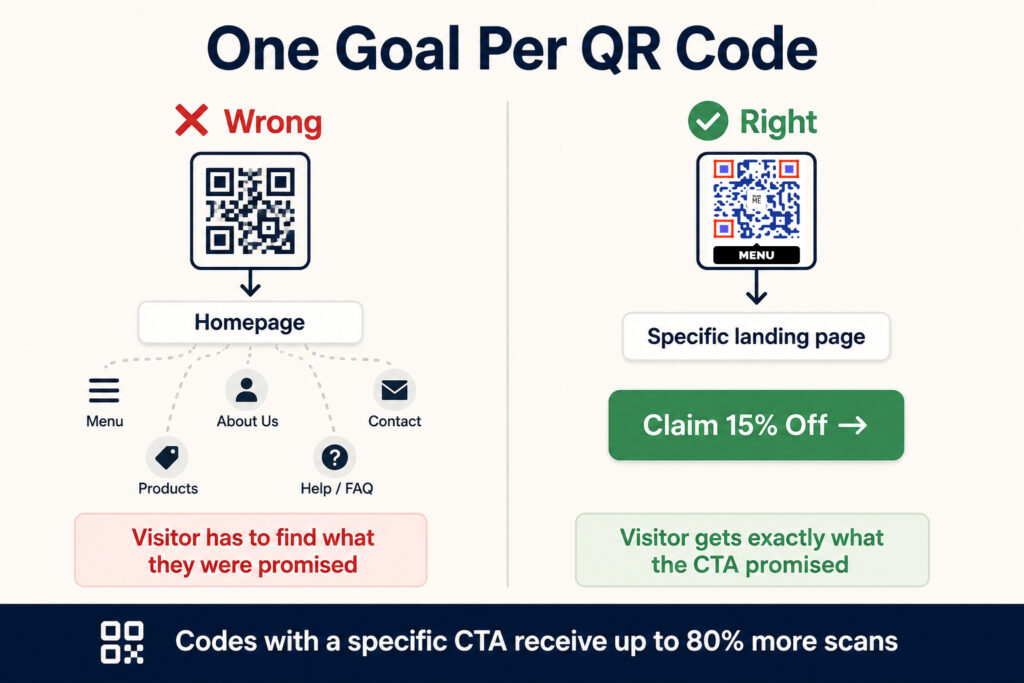
A scan is a moment of high intent. The person has stopped, taken out their phone, and completed a deliberate action. That intent should be met with a single specific next step that matches exactly what the physical asset promised.
| Physical asset CTA | Wrong destination | Right destination |
|---|---|---|
| “Rate your experience” | Homepage | Direct Google review link |
| “See how it works” | Product page | 30-second demo video |
| “Get early bird tickets” | Event homepage | Ticket checkout with offer applied |
| “Connect on LinkedIn” | Company website | LinkedIn profile or vCard download |
| “This week’s offer” | Online store homepage | Landing page for that specific offer |
Always include a call-to-action on the code
A QR code with no explanatory text is a mystery box. Most people will not scan something when they have no idea what they will get. Always include a specific CTA frame: “Scan to see our menu”, “Scan to claim your 15% discount”, “Scan to watch the video.” Codes with a contextual CTA consistently receive up to 80% more scans than codes displayed without supporting text.
Strategy 1: Drive Traffic from Print to Digital
The most straightforward QR code marketing application is converting passive print readers into active digital visitors. This works across every format where print still plays a role: catalogues, brochures, direct mail, magazine ads, and leaflets.
- Catalogues and brochures: Add a QR code next to each product linking to the live product page, current pricing, or a video demo. Update the destination as prices change – no reprint needed. Embed a qr code for pdf in printed materials to deliver catalogs, lookbooks, or guides instantly.
- Direct mail: A personalised URL combined with a QR code is one of the highest-converting direct mail tactics available. The recipient scans to a page that references them by name and pre-fills their details in any form.
- Magazine and newspaper ads: Link to extended content – a longer video, a full case study, a competition entry page. The ad creates interest; the QR code delivers depth that print cannot.
💡 Track each print asset separately. Create a unique dynamic QR code for each printed piece – one for the catalogue, one for the direct mail, one for the magazine ad. This tells you which channel drives the most scans so you can allocate budget at your next campaign review based on actual data, not guesswork.
Strategy 2: Build Email and SMS Lists from Physical Locations
Physical locations – retail stores, restaurants, clinics, gyms, hotels – have something most digital marketers would pay a premium for: a captive audience of people who have already chosen to engage with your brand. QR codes turn that physical presence into a list-building opportunity.
Place a QR code at high-dwell locations – table tops, counters, waiting areas, checkout queues – that links directly to a sign-up page. The offer needs to provide immediate, tangible value to justify the friction of entering contact details.
High-converting physical list-building offers:
- “Scan to get 10% off your next visit” – retail and hospitality
- “Scan to join our loyalty program and earn points from today”
- “Scan to receive our weekly menu and specials” – restaurants and cafes
- “Scan to download our free guide to [topic]” – services and B2B
- “Scan to enter our monthly prize draw” – high-footfall retail
✅ Why this works: The person is already in your location, which means they have demonstrated willingness to engage. The barrier to signing up is much lower than a cold digital acquisition campaign – and the resulting subscriber quality tends to be higher because they are already customers or prospects in your physical space.
Keep the sign-up form to a single field – email only, or phone number only. Every additional field reduces completion rate significantly. Connect directly to your email or SMS platform so the welcome message or discount code arrives automatically within seconds of scanning.
Strategy 3: Deliver Exclusive Content and Gated Offers
Exclusivity creates value. A QR code that unlocks something not available elsewhere gives people a clear reason to scan. The key word is exclusive – if the destination is something the person could find by Googling your brand name, the QR code adds no value. The code should genuinely unlock something they cannot get any other way.
- Retail in-store: “Scan for today’s in-store exclusive offer – not available online.” Drives footfall and gives customers a reason to visit rather than order online.
- Product packaging: “Scan for extended warranty registration and care guide.” Adds value to the product ownership experience post-purchase.
- Books and printed guides: “Scan to access companion resources – templates, checklists, and bonus content.” Publishers use this to add digital value to physical products.
- Events: “Scan to access speaker slides and session recordings.” Extends the value of attending beyond the closing session.
💡 Use a dynamic code so exclusive content stays fresh. If you print packaging with “scan for our summer recipe collection”, you need to update that destination when autumn arrives. A dynamic code makes this a one-minute change in your dashboard rather than a costly reprint.
Strategy 4: Collect Reviews at the Moment of Satisfaction
Online reviews directly influence purchasing decisions. According to BrightLocal’s 2023 Local Consumer Review Survey, 98% of consumers read online reviews for local businesses, and 46% trust them as much as personal recommendations. Yet most businesses struggle to collect reviews consistently because they ask at the wrong time.
The right time is immediately after a positive experience – when the meal is finished, the appointment completed, the purchase made. A QR code placed at exactly that moment can dramatically increase review collection rates. The code should link directly to your Google review form – not to a landing page that then links to Google. Every extra click reduces completion rate.
| Business type | Best placement | CTA text |
|---|---|---|
| Restaurant | Bill folder or dessert menu | “Enjoyed your meal? Leave us a Google review” |
| Salon / clinic | Reception desk on checkout | “Happy with your visit? 30 seconds to review us” |
| Retail | Inside the shopping bag | “Love your purchase? Tell Google” |
| Hotel | In-room card on pillow or desk | “Rate your stay and help other travellers” |
| Service business | Printed thank-you note with invoice | “Your review helps others find us” |
⚠️ Google’s policies prohibit incentivising reviews. Do not offer a discount or reward in exchange for leaving a review. The QR code is simply removing friction from the process – not incentivising the outcome.
Strategy 5: Enable Frictionless Product Purchases
Every step between interest and purchase reduces conversion rate. QR codes that link directly to a buy-now page eliminate the friction of typing a URL, searching a website, or hunting for a product in a catalogue. This is particularly effective in retail environments where a product is on display but not in stock, and in out-of-home contexts where impulse purchasing is possible.
- In-store displays: A QR code on a display stand linking to the online purchase page lets customers buy even if the size or colour they want is out of stock in that location.
- Packaging reorder: “Scan to reorder” – link directly to the add-to-cart page for that specific SKU. Subscription businesses use this to convert one-time buyers into subscribers.
- Print ads: A poster for a product can link directly to the purchase flow. Especially powerful for event tickets, where the person is actively deciding whether to buy when they see the ad.
- B2B leave-behinds: A QR code on a sales leave-behind linking to a booking calendar converts a passive reference into an active conversion tool.
✅ Pre-fill where you can. If linking to a form or checkout, use URL parameters to pre-fill any information you already know – the product, the source, a discount code. Every field you pre-fill increases completion rate meaningfully.
Strategy 6: Run Measurable Out-of-Home Campaigns
Out-of-home advertising – billboards, bus shelters, transit ads, street posters – has historically been one of the hardest channels to measure. Dynamic QR codes change this entirely by turning every OOH placement into a trackable digital touchpoint.
Each OOH placement should have its own unique dynamic QR code. One placement, one code, one analytics stream. The creative approach for OOH QR codes differs from print because viewing time is often only seconds:
- Apply the 10:1 rule for sizing – code width should be at least 1/10th of the expected scanning distance. A code that is too small to scan comfortably generates near-zero scans regardless of how good the campaign is.
- The CTA must be instantly readable: “Scan for today’s deal”, “Scan to win”, “Scan to see inside.” Vague CTAs fail entirely in OOH contexts.
- The destination must load in under 2 seconds on a mobile data connection. People scanning on the street are not on WiFi.
💡 OOH benchmark: A well-placed 6-sheet poster with a compelling CTA in a high-footfall urban location generates between 50 and 200 scans per week. A billboard with a code that is too small generates near zero. Size matters significantly more in OOH than in any other format.
Strategy 7: Enhance Packaging with Post-Purchase Engagement
Every branded package that leaves your warehouse is a physical touchpoint with a confirmed buyer – someone who has already paid and is more receptive to your brand message than almost any cold audience. Dynamic codes on packaging let you update the destination as campaigns evolve – summer promotion in June, gift guide in November, New Year offer in December – all from the same printed code.
| Goal | Destination | CTA on pack |
|---|---|---|
| Product education | How-to video or setup guide | “Scan to see it in action” |
| Reorder / subscription | Direct add-to-cart or subscription page | “Running low? Scan to reorder” |
| Community building | Private Facebook group or Discord invite | “Join 40,000 [brand] owners” |
| Warranty registration | Simple registration form | “Scan to activate your 3-year warranty” |
| Review collection | Google or Trustpilot review link | “Love it? Scan to review” |
| Loyalty / rewards | Loyalty program sign-up or points credit | “Scan to earn 500 points” |
For a deeper guide to this use case, see our article on QR codes on product packaging.
Strategy 8: Personalise Events and Conference Experiences
Events generate enormous amounts of print collateral – badges, programmes, handouts, signage – that are typically discarded within days. QR codes make that collateral interactive and measurable, and create new ways to personalise the attendee experience.
- Attendee badges: A QR code on each badge linking to the attendee’s LinkedIn profile replaces the awkward “let me find you on LinkedIn” phone fumble at networking events.
- Session materials: Rather than printing slides, print a QR code linking to a digital resource pack. Update it after the event if you need to add materials – no reprint needed.
- Sponsor activations: Exhibition stands with QR codes linking to a demo or lead capture form convert passive foot traffic into measurable leads, with each sponsor getting their own code and analytics.
- Post-event engagement: Codes on delegate bags linking to session recordings or a follow-up resource hub extend the value of attending beyond the event itself.
For a full guide, see our article on QR codes for events.
Strategy 9: Retarget Offline Audiences Online
One of the most powerful but underused QR code marketing strategies is using scan data to build retargeting audiences in digital advertising platforms. This closes the loop between offline and online marketing in a way that was not possible before dynamic QR code analytics.
When someone scans your QR code and visits your landing page, their browser sends the same signals as any regular website visitor. This means you can fire tracking pixels (Meta Pixel, Google Ads tag, TikTok Pixel) on the QR code landing page and add scanners to custom audiences for retargeting.
The flow: person scans your in-store or print QR code → lands on your mobile landing page → tracking pixel fires → they are added to a custom audience segment → over the next 7–30 days, they see follow-up ads in their social feeds → the retargeting ad closes the purchase they considered but did not complete at the point of scan.
✅ Why this works: People who scanned your QR code are warm – they demonstrated active, deliberate interest. Retargeting audiences built from QR code scanners consistently outperform cold audiences in click-through and conversion rates because the initial intent signal was physical and voluntary, not algorithmic.
Use UTM parameters on destination URLs so you can segment scanner traffic from other web traffic in Google Analytics 4, and build custom audiences in your ad platforms to capture only visitors from those specific QR code landing pages.
Strategy 10: A/B Test Physical Marketing Materials
A/B testing is a cornerstone of digital marketing – run two versions of something, let data determine the winner. Until dynamic QR codes, this was practically impossible for physical marketing. Now it is straightforward: create two versions of a physical asset, assign a unique dynamic QR code to each, track scan rates over the same time period, and let the data pick the winner.
Examples of what you can test:
- CTA text: “Scan for 15% off” vs. “Scan to see today’s offer” – which drives more scans?
- Code placement on the same asset: Top-right vs. bottom-left – does position affect scan rate?
- Size: Larger code vs. smaller code – at what size does scan rate decline?
- Landing page split test: Send 50% of scanners to version A and 50% to version B – which converts better?
- In-store location: Same flyer in two different areas of the store – which location generates more scans?
Brands that run structured tests on physical materials consistently improve scan rates and conversion rates over time – the same compounding improvement that digital marketing teams achieve through continuous optimisation.
The Post-Scan Experience: Where Most Campaigns Win or Lose
The QR code is a delivery mechanism. The post-scan experience – the mobile page the person arrives at – is where your campaign is actually won or lost. Industry data consistently shows scan-through rates of 20–40% on well-placed codes, but conversion rates on the landing page are often below 5%. The gap is almost always the post-scan experience, not the code or its placement.
Mobile-first is not optional
Every person who scans a QR code is on a smartphone. If your landing page is not optimised for mobile – small text, hard to tap buttons, requires pinch-to-zoom – you will lose the majority of scanners within the first 3 seconds. Test every QR code destination on at least three different phone screen sizes before any print run.
Speed is a conversion factor
Google’s research shows a 1-second delay in page load time reduces conversions by approximately 7%. For mobile pages loaded over a 4G connection – the typical QR scan scenario – aim for a load time under 2.5 seconds. Use Google PageSpeed Insights to measure and improve your landing page performance before printing.
Match the destination to the promise exactly
If your QR code CTA says “Scan for 20% off”, the landing page must show the 20% discount offer immediately, above the fold, without requiring any scrolling. Any mismatch between what the CTA promised and what the landing page delivers causes immediate abandonment.
| Post-scan experience factor | Benchmark to hit |
|---|---|
| Page load time (mobile, 4G) | Under 2.5 seconds |
| Key content visible without scrolling | Yes – above the fold |
| Number of CTAs on landing page | 1 primary action only |
| Form fields (if applicable) | Maximum 2–3 fields |
| Mobile usability score (Google) | 90+ via Search Console |
Measuring QR Code Marketing Performance
Dynamic QR code analytics gives you a set of metrics that simply did not exist for physical marketing before. Understanding what to measure – and what each metric tells you – is essential for improving campaign performance over time.
Core QR code metrics
- Total scans: Raw scan count. A sudden drop indicates a physical problem with the asset – covered, damaged, or removed.
- Unique scans: Individual devices that scanned. Total scans divided by unique scans gives you average repeat scan rate – relevant for codes in high-visit locations like restaurant tables.
- Scan location: Where in the world scans are originating – tells you which geographic placements are most responsive.
- Device breakdown: iOS vs. Android split – relevant if your landing page performs differently across operating systems.
- Scan time distribution: When during the day and week scans occur. Informs offer timing, staffing decisions, and content scheduling.
For more on QR code analytics and what you can do with scan data, see our trackable QR codes guide.
Connecting QR analytics to business outcomes with UTM parameters
Add UTM parameters to every QR code destination URL so scans appear as a distinct traffic source in Google Analytics 4. Standard UTM structure for QR codes:
- utm_source = qr-code
- utm_medium = print (or outdoor, packaging, event)
- utm_campaign = campaign-name
- utm_content = asset-name (e.g. manchester-poster, spring-catalogue)
With this in place, you can report on QR-driven revenue, sign-ups, or leads with the same precision as any digital channel – and make budget allocation decisions based on comparable ROI data.
7 QR Code Marketing Mistakes to Avoid
1. Using static codes for campaigns
Static codes cannot be updated or tracked. Any code printed on a physical asset for a marketing campaign should be dynamic. The cost difference is minimal; the capability difference is enormous.
2. Pointing all codes to the homepage
A QR code that lands on your homepage forces the person to find what the CTA promised on their own. Most will not. Each code needs a destination that fulfils the exact promise made at the point of scan.
3. No call-to-action on the code
A QR code without explanatory text is a mystery box. Most people will not scan something they do not understand. Always include a specific CTA that tells them what they will get.
4. Codes that are too small
The minimum size for reliable scanning at arm’s length is 2.5 × 2.5 cm. For codes scanned from a distance, apply the 10:1 rule. Small codes consistently underperform because many people will attempt to scan, fail once, and not try again.
5. Not testing on a physical proof
A QR code that scans perfectly on screen can fail on a printed surface due to ink bleed, paper texture, or reflective coating. Always test on a physical proof of the actual material before committing to a production run.
6. No analytics review after launch
Printing the code is not the end of the campaign. Set a calendar reminder to review scan data one week after launch and monthly thereafter. The analytics data is your feedback loop for improvement.
7. Codes that expire
Some QR code platforms place expiry dates on free-tier codes. A code on a printed asset that expires six months into a year-long product run is a broken user experience. Use a platform like OpenQR that guarantees non-expiring codes on any active plan.
Frequently Asked Questions
How many QR codes do I need for a marketing campaign?
Create one unique dynamic QR code per physical placement and per campaign goal. If you are running a campaign across three different print formats – a flyer, a poster, and a direct mail piece – use three separate codes even if they point to the same destination. This gives you scan data per format so you can identify which channel is most cost-effective and allocate budget accordingly.
What is a good QR code scan rate for a marketing campaign?
Scan rates vary by context, placement quality, and CTA clarity. For in-store placements with a relevant offer, 2–8% of estimated footfall is achievable. For OOH advertising, 0.1–0.5% of impressions is typical. Direct mail with a QR code generally sees 1–3% scan rates. These benchmarks improve significantly with a well-designed CTA, proper sizing, and a compelling offer behind the scan.
Should every QR code campaign have its own landing page?
Ideally yes – a purpose-built landing page that matches the specific CTA will always convert better than a generic website page. The most important requirement is that the destination loads quickly on mobile, delivers exactly what the CTA promised, and has a single clear action. If an existing page meets these criteria, it can work without building a new one.
Can QR codes work for B2B marketing?
Yes, and they are significantly underused in B2B contexts. High-performing B2B QR code applications include business cards linking to LinkedIn profiles or meeting booking calendars, conference materials linking to case studies or demo request forms, and direct mail linking to personalised video messages or ROI calculators.
What is the difference between a QR code campaign and just printing a URL?
A URL on print requires the person to type it manually into a browser – a process that dramatically reduces response rates compared to scanning. A QR code removes this friction entirely. Additionally, a dynamic QR code provides analytics that a printed URL never can, and can be updated if the destination changes. For any print asset where you want a meaningful response rate, a QR code consistently outperforms a printed URL.
How do I get people to actually scan my QR code?
Three elements drive scan rate: clear visual prominence (large enough to notice at the expected viewing distance), a compelling CTA that explains the value (“Scan to claim your 20% discount”), and placement context (the code should appear at a moment when the person has time and motivation to scan). At venues with staff, a verbal mention significantly increases scan rates.
Build Your QR Code Marketing Strategy with OpenQR
Dynamic codes, real-time analytics, branded design, UTM tracking, and no expiry dates – everything you need to run QR code marketing campaigns that are measurable, flexible, and built to last.