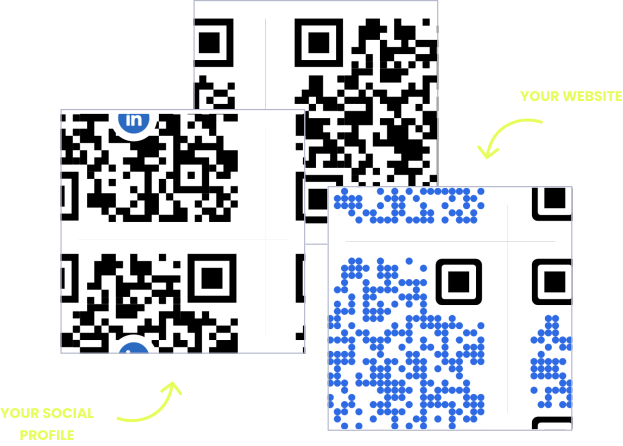
WITHOUT OPENQR
- Wall labels frozen with whatever fit at install
- Audio guide hardware to buy, clean, and maintain
- Reprinting interpretation panels when research updates
- No sense of which works visitors engage with most
WITH OPENQR
- As much interpretation as the object deserves
- Audio guides on the visitor's own phone, no hardware
- Update the content from the dashboard, not the printer
- Scan analytics show which works draw attention
Collections deserve smarter QR codes
A wall label holds a few dozen words, printed once and frozen at install. But the object beside it has far more to give: the artist’s story, the conservation history, a zoomable detail, an audio narration, the research that keeps evolving after the exhibition opens. The label cannot grow, so most of what a curator knows never reaches the visitor standing right in front of the work.
A dynamic QR code from OpenQR turns the object itself into a doorway. A small, discreet code beside the piece opens as much interpretation as you want to offer – text, images, audio, video – on the visitor’s own phone. When new research arrives or the display changes, you update the content from your dashboard, and every code in the gallery reflects it. The printed label stays quiet on the wall; what it opens keeps deepening.
HOW MUSEUMS USE OPENQR
One code. Endless ways to use it.
Pick the right QR type for the job – every one is dynamic, trackable, and editable long after it is printed.
Exhibit labels that hold the whole story
A small code beside the work opens everything the wall label cannot fit: the full description, the artist, provenance, and context. Update the interpretation as research develops, and the code beside the piece always opens the current version.
USES: URL QR CODEAudio guides on the visitor's phone
Replace rented headsets with a code that opens narration on the phone already in the visitor’s pocket. No hardware to buy, charge, or sanitize – and you can add a track for a new piece the day it goes on display.
USES: PDF QR CODESelf-guided routes through the collection
A code at the entrance opens a themed route – highlights, a childrens’ trail, an accessibility path. Reorder the stops or add a new theme anytime; the printed sign at the door never changes.
USES: URL QR CODECatalogs and exhibition guides
Upload the exhibition catalog or gallery guide as a PDF and the code on the handout or panel opens it. Visitors take the full document home in a scan, and you revise it without reprinting the printed guide.
USES: PDF QR CODESupport, membership, and the shop
A code at the exit opens membership signup, a donation page, or the online shop – inviting a visitor who just had a good visit to stay connected, without a hard ask on the wall.
USES: URL QR CODEThree tips for museum QR codes that get scans
Discreet, but readable
A code beside an artwork should not compete with it. Keep it small and understated on the label, but not so small the camera struggles – test the scan from where a visitor naturally stands, a step back from the piece.
Mind the gallery lighting
Museum lighting is deliberately low, and glass cases add reflections. Place codes on a matte surface where a little light falls, off the glare of the case glass, and test a scan in the actual gallery conditions.
Say what waits, quietly
A small line – “Scan for audio”, “Scan for the full story” – tells visitors the code is worth their phone. An unlabeled square next to a masterpiece reads as signage clutter and gets ignored.
Built for museums and galleries
Interpretation without limits
As much story, audio, and image as an object deserves – behind a small code, not crammed onto a wall label.
No audio-guide hardware
Narration plays on the visitor’s own phone. Nothing to buy, charge, sanitize, or replace when it walks out the door.
Update as research develops
New attribution, new conservation findings, a corrected date – edit the content from your dashboard and every code updates.
Scan analytics per work
See which pieces and routes visitors engage with most, and when. GDPR compliant with no IP addresses stored.
QR solutions museums and galleries use most
How OpenQr helps you
Boost engagement and insights through dynamic, customizable QR codes.
Track every scan and optimize smarter
Know exactly when, where, and how your QR Codes are scanned. See device types, locations, and scan frequency – and use data to improve your campaigns and boost ROI.
Read more
Make every QR code uniquely yours
Customize your QR Codes with brand colors, logos, call-to-action text, and even creative frames or edges. Stand out, stay on-brand, and drive more engagement from every scan.
Read more
Update links anytime – even after printing
Dynamic QR codes let you change your URL or content at any time without needing to reprint. Perfect for evolving research, new audio tracks, or updating interpretation without new labels.
Read moreNo credit card required
Why museum QR codes deepen every visit
Museum QR codes exist to solve a limit as old as the wall label: a printed caption holds only a few dozen words, but the object beside it holds far more. There is the artist’s life, the provenance, the conservation story, the scholarship that keeps evolving. So a curator’s knowledge gets compressed into whatever fit at install, and the rest never reaches the visitor. A dynamic code lifts the limit – the label points to as much interpretation as you choose to offer, in text, image, audio, or video.
The practical gains stack up fast. Audio guides move from rented hardware to the visitor’s own phone, so there is nothing to buy, charge, or clean. Interpretation updates from a dashboard instead of a reprint, so a new attribution or a corrected date reaches the gallery the same day. And because the content is digital, it can be richer and more accessible than any panel – larger text, multiple languages, described images. Our free vs paid QR generator guide covers the cost side.
The gallery becomes measurable
For the first time, engagement becomes visible. A museum has never really known which works hold a room and which get walked past – footfall is anonymous. But when each piece has its own code, a scan is a quiet signal of genuine interest, with a time attached. So curators can see which objects draw people in, which routes get followed, and where attention fades. That is planning data no visitor survey ever captured, gathered without interrupting the visit.
The same discretion that makes a code respectful also makes it optional, which suits a gallery. The visitor who wants only the art sees a small, quiet square and ignores it. The visitor who wants the whole story scans and gets it. Start with the pieces that raise the most questions, or with an audio route through the highlights, and expand as the scan data shows you where curiosity lives. Our guide to QR placement covers where codes get noticed.
As much story, audio, and image as an object deserves, behind one small code.
New findings update from the dashboard and reach the gallery the same day.
Audio guides play on the visitor’s own phone. Nothing to buy, charge, or sanitize.
Each work reports its own scans, so you learn which pieces genuinely draw attention.