
A branded van is seen by thousands of people a day, and almost none of them can scan it. Most are driving, the van is moving, and the code is on a ribbed side panel under a layer of road spray. The scans a vehicle actually gets come from a short list of moments: parked outside a customer’s house, queuing at the lights with passengers in the car behind, standing at a food truck hatch. Put the code where those moments happen, on a surface that survives years of weather and car washes, and the vehicle becomes the most widely seen QR code your business owns.
The benefits of using QR codes on vehicles
A branded company car or van is advertising you already paid for. It drives through your service area every day, parks outside your customers’ homes and sits in traffic in front of hundreds of people. A QR code on the vehicle takes that audience from offline to online: the neighbour who sees your van outside the house next door can save your number, get a quote or read your reviews in the time it takes to walk past. Without a code, the same person has to remember your name and search for it later, and most never do.
It also shows what the branded vehicle returns for its cost. Every scan is counted by day, time and city, so you can see whether the wrap brings in work and which vehicle, route or area does best. And because a vehicle wrap stays on for years while phone numbers, offers and websites change, a dynamic QR code keeps the vinyl as it is and lets you change where the code goes from your dashboard.
What a vehicle QR code has to handle
An audience that is mostly driving
Most people who see a vehicle are behind a wheel and must not scan it. The code has to work for passengers, pedestrians and people standing next to the vehicle when it is parked, which decides where on the bodywork it goes.
Ribs, curves and door handles
Panel vans have pressed ribs along the sides, cars have curved doors, and every vehicle has handles, hinges and fuel caps. A code across any of them is bent or broken before the first scan.
Road spray, car washes and sun
The lower part of a vehicle is covered in dirt within a day, car wash brushes catch the edges of decals, and years of sun fade the print. A code that scans in the wrap shop may not scan after one winter.
A wrap that outlasts the details
Vehicle graphics stay on for years. Phone numbers, offers, service areas and websites change long before that, and vans get sold with the wrap still on. The code must stay editable for the life of the vinyl.
QR solutions that work best on a vehicle
Three mistakes that stop a vehicle QR code scanning
Printing it on perforated window film
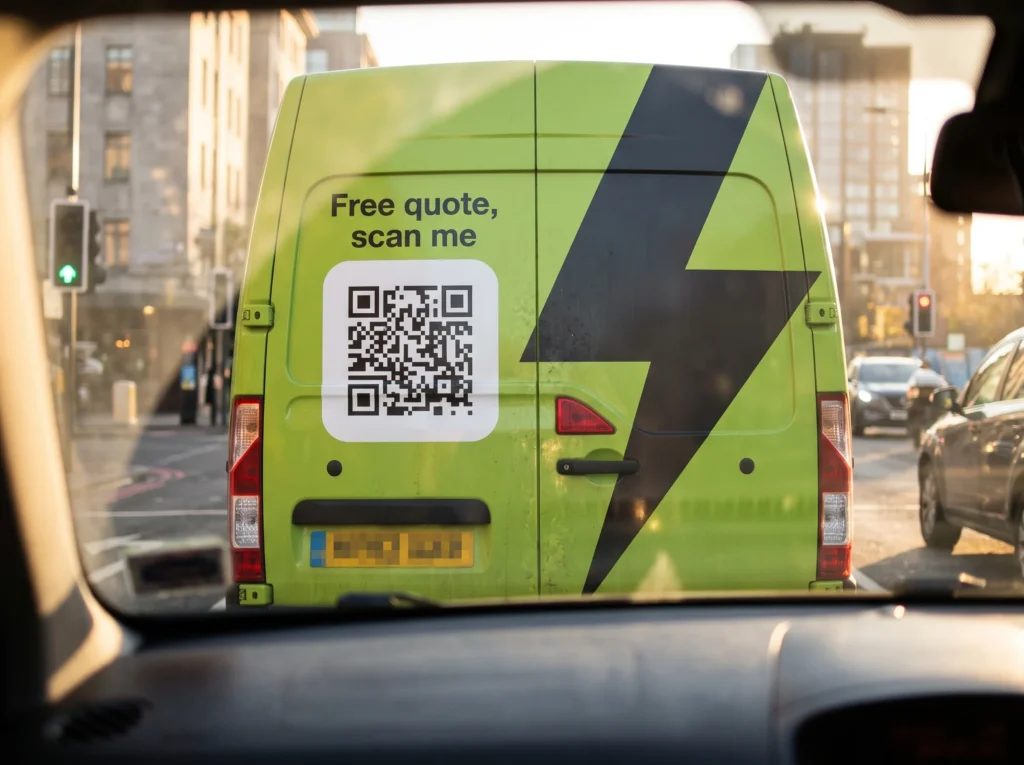
The one-way vision film used on rear and side windows is half holes, so drivers can see out. A QR code printed on it loses half its modules to the holes and almost never scans. Put the code on solid vinyl on the bodywork, or on a solid patch cut into the window graphic.
Low on the bumper or the sill
Bumper stickers and codes along the bottom of the doors are covered in road spray within a day and sit below where anyone holds a phone. Keep the code above about 1 m from the ground, on the rear doors or the upper half of a side panel.
Across a rib, a seam or a handle
Panel van sides are pressed into ribs, and rear doors have a central seam, handles and hinges. A code laid across any of them is folded or cut in two. Measure the flat areas on the actual vehicle before the wrap is designed, and fit the code inside one.
WHAT TO LINK FROM YOUR VEHICLE
One code. Endless ways to use it.
Pick the right QR type for the job – dynamic codes stay editable and trackable for as long as the wrap stays on.
Call the plumber parked next door
Trades get work from the neighbours of the job they are on. A phone QR code on the side of the van puts your number in the dialler, ready to press, while the van is parked outside. If the number changes, update the code and leave the wrap alone.
USES: PHONE QR CODEFree quote or first consultation
Advisers, cleaners, landscapers and removal firms can send the scan straight to a short quote form or a booking page, with a first-visit offer if you want one. People in the queue behind can save it and fill it in later.
USES: URL QR CODEFood truck: menu today, location tomorrow
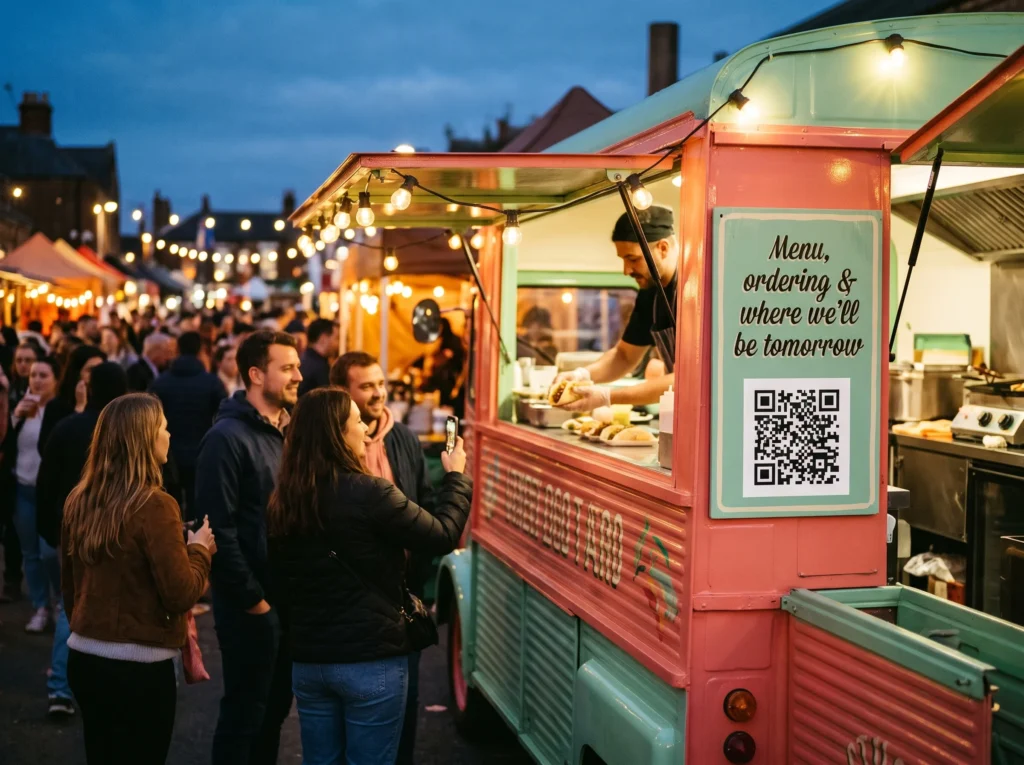
A link list QR code beside the hatch opens one page with today’s menu, ordering, this week’s locations and your social profiles. Update the locations every morning and the truck carries its own timetable.
USES: LINK LIST QR CODEOrder the pizza on the car
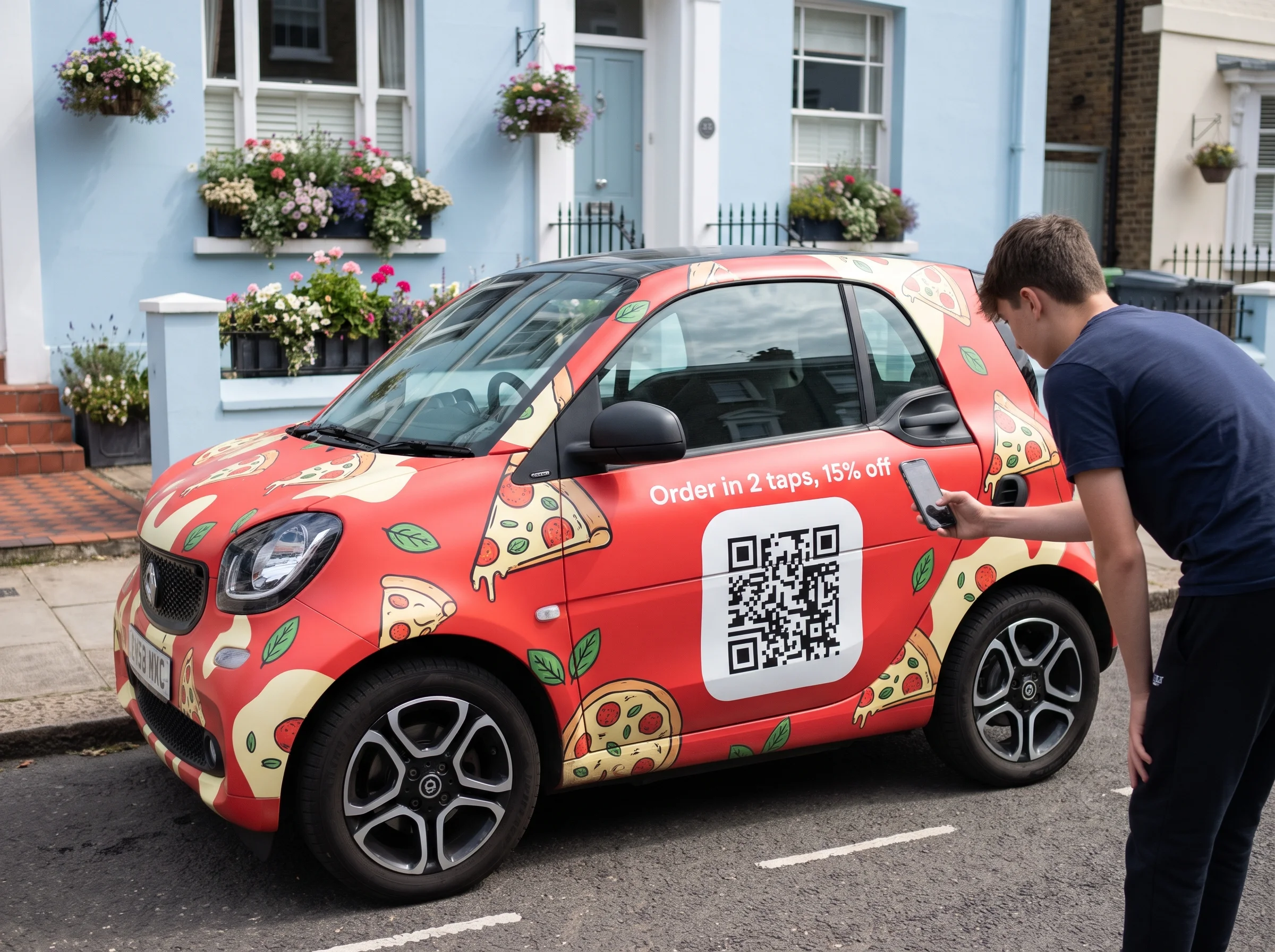
A delivery car parked outside one house is an advert for the whole street. Link the code to your ordering page with a first-order offer, and change the offer from the dashboard each month.
USES: URL QR CODERate this driver, report this vehicle
Give each fleet vehicle its own code that opens a short feedback form with the vehicle number already filled in. Customers rate the delivery, and members of the public can report how a vehicle is driven or parked.
USES: URL QR CODEUnlock, ride and take the tour
Car-share cars, rental bikes, scooters and city tour buses carry the code for their own app. An app download QR code opens the right store for iPhone or Android, so the first ride starts with one scan.
USES: APP DOWNLOAD QR CODEWITHOUT OPENQR
- A code on the bumper, covered in road spray by lunchtime
- Printed on window film, half of it lost to the holes
- A ribbed panel folding the code in two
- The phone number changes and the whole wrap has to go
WITH OPENQR
- Code above 1 m, on the rear doors and the side near the door
- Solid vinyl on the bodywork, matte laminate over the code
- Fitted inside a measured flat area of the panel
- Edit the destination, keep the wrap for its whole life
What goes wrong with QR codes on vehicles
Vehicles fail on placement before anything else. Wrap designs are drawn on a flat template of the vehicle, where the bumper, the window film and the ribbed lower panel all look like useful space. On the road, the bumper is covered in spray, the window film is full of holes, the ribs bend the code, and the panel that looked central on the template is where pedestrians never stand. The scans that do happen come from people next to a parked vehicle or passengers in the car behind, and a code placed for the template rather than for those people is the reason a wrap seen by thousands gets scanned by a handful.
The second problem is time. A vehicle wrap is printed once and stays on for years, through phone number changes, new service areas, a new website and sometimes a change of owner. A static QR code fixes the destination on the day the wrap is fitted, so any of those changes leaves the code pointing at the wrong place, or at nothing. A dynamic QR code keeps the vinyl and moves the destination, so the van keeps working when the business changes, and the scan counts per vehicle show which ones actually bring in work.
Where on the vehicle the code gets scanned
Plan the code for the person who will scan it, not for the space on the wrap. Nobody should scan while driving, so the useful moments are a parked vehicle, a queue at the lights with passengers in the car behind, and a vehicle people walk up to. Scanning distance divided by ten gives the size.
| Position | Who scans it, from where | Size | Verdict |
|---|---|---|---|
| Rear doors of a van | Passengers in the car behind, people walking past a parked van, 2 to 3 m | 200 to 300 mm | The best spot on most vans |
| Side panel near the sliding door | Neighbours and passers-by when parked, 1 to 1.5 m | 100 to 150 mm | Good, on a flat area above 1 m |
| Car rear side window | Pedestrians beside a parked car, about 1 m | 100 mm | Only on solid vinyl, never on perforated film |
| Food truck, next to the hatch | Customers in the queue, 0.5 to 1 m | 50 to 100 mm | Excellent, people are already waiting |
| Bike, scooter or car-share door | The next user, arm’s length | 30 to 50 mm | Excellent, the code is the way in |
| Bumper or sill | Nobody, it is low and dirty | – | Avoid |
| Bonnet or roof | Nobody can reach or see it | – | Avoid |
On the rear doors, keep the code on one door, clear of the central seam, the handle and the number plate light. On the side, put it near the sliding door, because that is where the van is opened when it is parked and where neighbours see it. Keep every code above about 1 m from the ground, out of the spray zone. Add a line in large letters saying what the scan does, such as scan to call or scan for a free quote, and never ask people to scan while driving. For the full distance rule, see QR codes on posters, and for small decals on bikes and scooters, QR codes on stickers and labels.
Ribs, curves, wrap film and dirt
The vehicle’s surface decides whether a well-placed code still scans. Measure the flat areas on the actual vehicle, because the wrap template does not show the ribs, and choose the material for several years on the road.
| Surface or material | For the QR code | Why it matters |
|---|---|---|
| Ribbed van side panel | Fit the code inside one flat area between ribs | A rib across the code bends it out of square |
| Curved car door or wing | Use the flattest part, keep the code moderate in size | A large code on a tight curve distorts at the edges |
| Box truck or trailer side | Good, the panels are flat | Rivets and joints still break the code, avoid them |
| Gloss wrap laminate | Matte laminate over the code area | Gloss reflects the sun and the sky into the camera |
| Perforated window film | Never print the code on it | The holes remove half the modules |
| Magnetic sign | Good for a sole trader’s own car, on flat steel | Will not stick to aluminium panels, and it flies off on a curve |
| Colour of the wrap | Dark code on a white or light patch | Codes in brand colours on a dark wrap lose contrast |
A logo in the centre and a frame in your brand colours make the code part of the livery, as long as the code itself stays dark on light. Cast vinyl with a laminate lasts far longer than cheap calendared vinyl and copes better with car wash brushes, so ask your wrap installer for it on the code area at least. For file formats, send vector, as explained in our guide to print QR codes, and for the logo, see QR code with logo.
Years on the road: fleets, changes and resale
A vehicle wrap is one of the longest-lived pieces of print a business has, so plan the code for everything that will change while it is on the road.
| What changes | What to do with the code |
|---|---|
| Phone number or website | Point the code at the new one. The wrap stays |
| A new offer or season | Change the landing page behind the code |
| The service area grows | Send scans to a page listing the new areas |
| The vehicle is sold or the lease ends | Redirect the code to your website, or switch it to a page explaining the vehicle is no longer yours |
| A vehicle is off the road | Nothing, the codes on the others keep working |
With several vehicles, give each one its own code pointing at the same page, and name each code after the registration or the vehicle number. The dashboard then shows which van, which driver’s route and which area produces scans, and a feedback code per vehicle tells you which delivery the comment is about. Add campaign information to the destination with UTM parameters, so calls and bookings from the vehicles show up separately in your web analytics, as explained in how QR codes and URL parameters drive marketing ROI. Each code is one dynamic code on your plan; for a large fleet, the OpenQR API creates them from a vehicle list and you can contact us for a plan sized to the fleet.
Make every vehicle code dynamic before the wrap is printed. A static QR code encodes the destination in the pattern, so it cannot be changed once the vinyl is on and it cannot be converted to dynamic later. See static vs dynamic QR codes for the difference and trackable QR codes for what each scan records. For the delivery side of a fleet, see QR codes for logistics, and for a trade’s phone number on the van, phone number QR codes.
Then test it on the vehicle, not the proof. Ask the installer to fit the code area first, or tape a full-size print to the panel, park where customers will see it and scan from the real distance on two phones, one of them a few years old: from beside the side door, and from a car behind the rear doors. Do it once in bright sun and once after a drive in the rain. If it fails, move it before the full wrap goes on.
Where people stand behind or beside a parked vehicle. Never the bumper or the bonnet.
Out of the spray zone, inside one flat area, clear of seams and handles.
Never on perforated window film. Matte laminate stops the sun glaring.
Name it after the registration. See which van and which area brings in work.