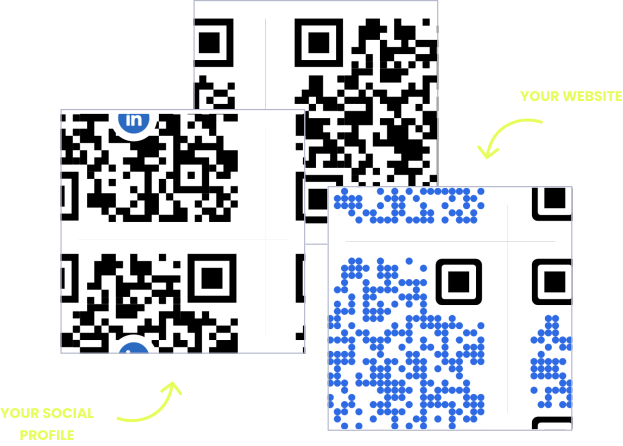
A garment has no single place to print on. The same QR code can go on a card hang tag, a printed care label, a woven neck label or straight onto the fabric, and each of those holds a different amount of detail. A code that scans first time on the hang tag turns into a blur when it is woven in thread at the same size. QR codes on clothing fail on the method, not the design, so decide where the code goes before you decide how big it is.
The benefits of using QR codes on clothing
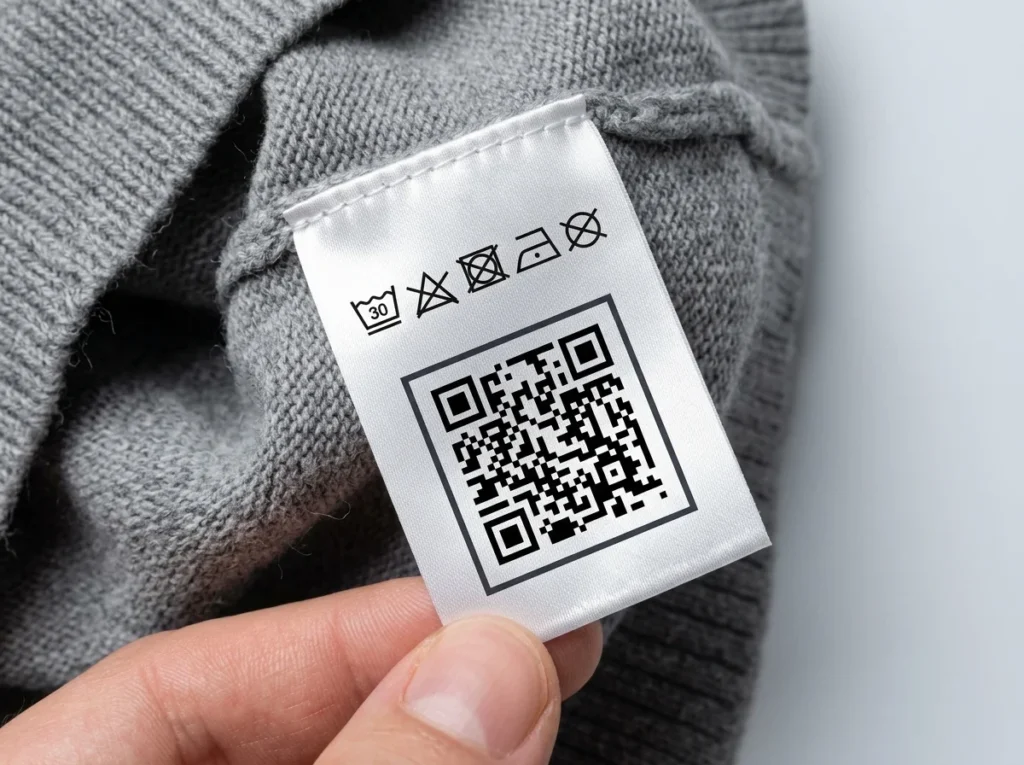
Clothing has the least room for information of anything sold in a shop and some of the most to say. Fibre composition, care symbols, size, origin and the same text again in every language of every market it ships to, all on a strip of satin a few centimetres wide. A QR code on a clothing label moves everything that does not have to be printed onto a page you control: the care guide, the size chart, how and where the piece was made, the rest of the collection and your social profiles.
It is also the only print that stays with the product for its whole life. Packaging is thrown away on day one. A sewn-in label is still there in year three, when the owner wants to know how to wash it, repair it or resell it. A dynamic QR code keeps the label fixed and the page behind it current, so a garment sold this season can still open a working page long after the collection has left the site.
What a clothing QR code has to handle
Four carriers, four resolutions
Card, printed satin, woven thread and ink on fabric each hold a different level of detail. A module that prints cleanly at half a millimetre on a hang tag needs about a full millimetre in a woven label and two on a T-shirt.
Fabric that stretches and creases
A QR code is read as a square with even spacing. Rib knit, jersey and anything with elastane pull that square out of shape, and a crease through the middle hides a row of modules from the camera.
Thirty washes and a tumble dryer
A care label is washed every time the garment is. Ink fades, satin frays and heat transfers crack, and a QR code loses its contrast long before the care symbols beside it become unreadable.
A product that outlives the season
Clothes are worn for years and sold on. Change the destination from your dashboard and every label already sewn in follows, from launch page to care guide to resale listing.
QR solutions that work best on clothing
Three mistakes that stop a clothing QR code scanning
Weaving a code that was sized for print
The artwork is approved on a printed proof and then sent to the label weaver at the same size. Thread cannot hold a half-millimetre square, so neighbouring modules merge. A woven QR code needs modules of about 1 mm, which means a 28 mm code on a 40 mm label, or a printed label instead.
Putting the only code on the hang tag
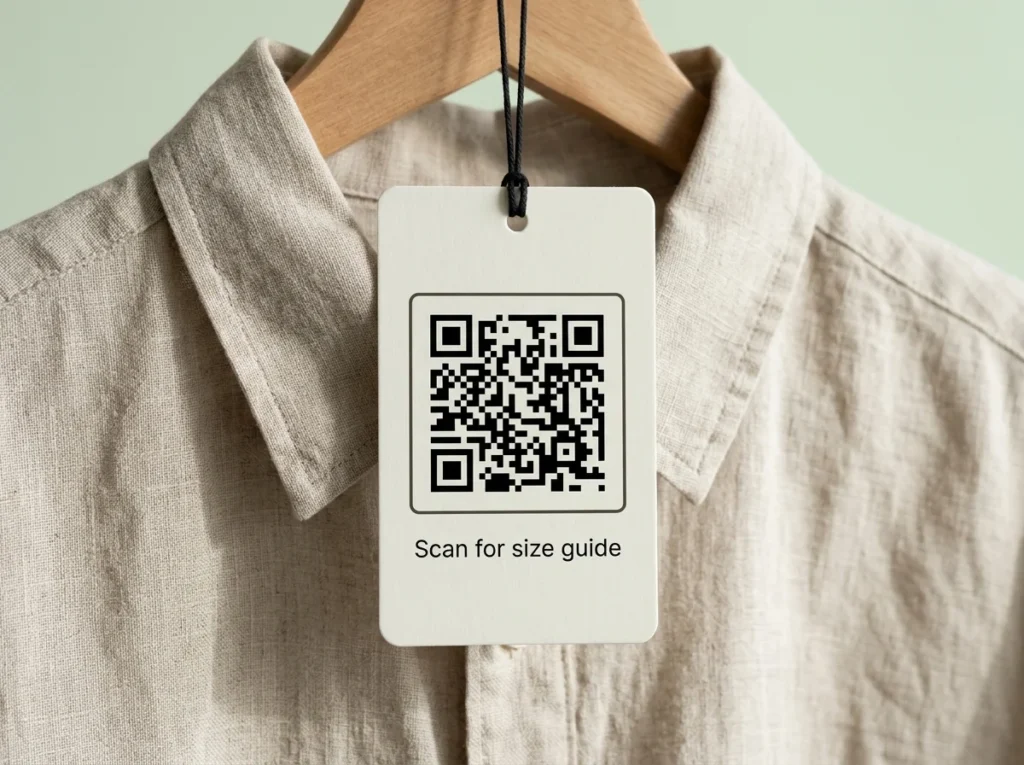
The hang tag is cut off before the first wear. That is fine for a lookbook or a size guide and wrong for anything the owner needs later, such as care instructions, repairs, resale or a product passport. Long-lived information belongs on the sewn-in label.
Printing across a seam, a rib or a stretch panel
Collar ribs, cuffs, side seams and stretch panels all distort the grid, and a heat transfer on rib knit cracks along the ribs within a few washes. Keep the code on a flat, stable part of the garment or on a label, where the fabric does not move.
WHAT TO LINK FROM YOUR CLOTHING
One code. Endless ways to use it.
Pick the right QR type for the job – every one is dynamic, trackable, and editable long after the labels are sewn in.
Care and repair, beyond five symbols
Upload the full care guide as a PDF and OpenQR hosts it. The label keeps the symbols the law asks for, and the QR code carries the washing advice, repair instructions and spare-button details that never fit on a strip of satin.
USES: PDF QR CODEMaterials, origin and the product record
A GS1 Digital Link QR code carries the GTIN of the garment in the code itself and opens a page with composition, origin and certifications. One code identifies the product to a scanner and explains it to the person holding it.
USES: GS1 DIGITAL LINKSize guide and the rest of the collection
A hang tag QR code that opens the size chart, the lookbook or the matching pieces answers the question people have in the fitting room. When the season changes, point the same tag at the new collection.
USES: URL QR CODEBand, club and creator merch
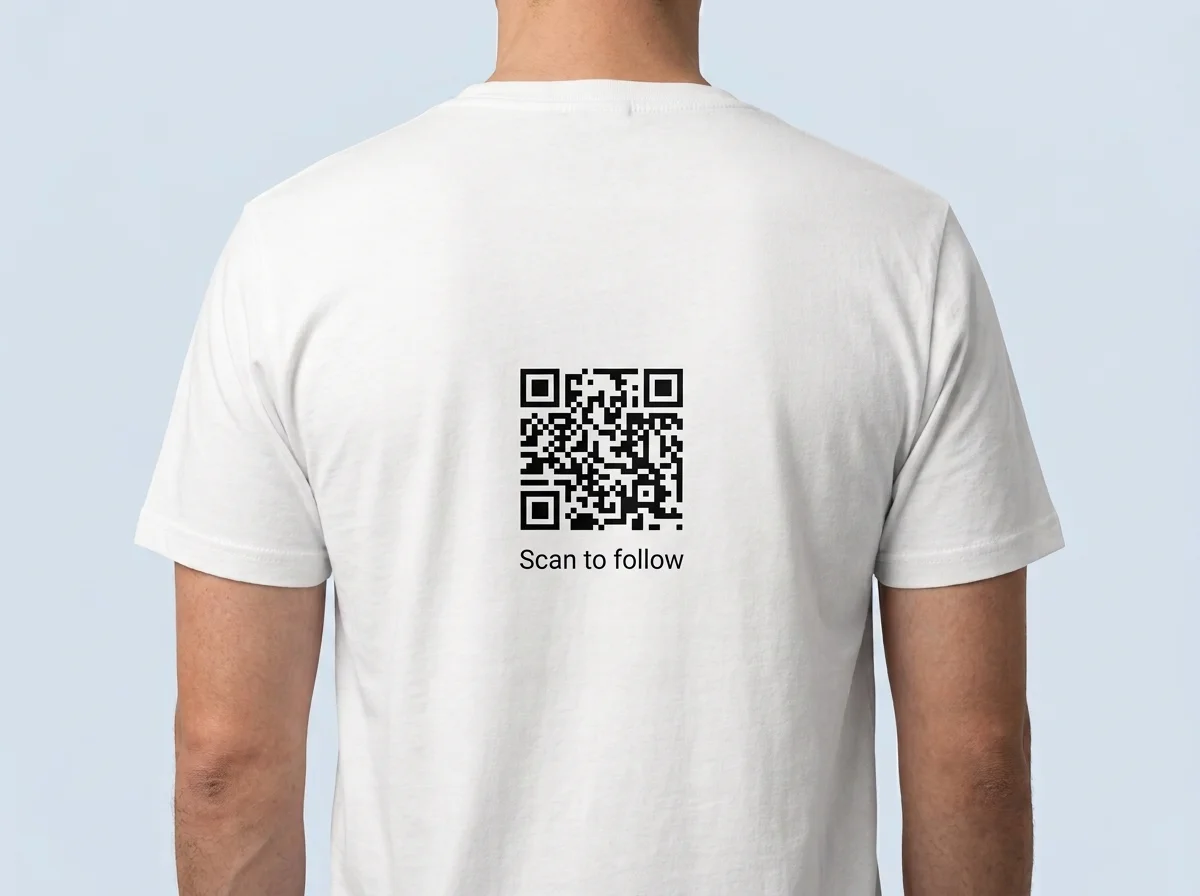
A printed QR code on a T-shirt or tote opens one page with your music, shop, tour dates and social profiles. The shirt stays in circulation for years, so the links behind it need to be editable for just as long.
USES: LINK LIST QR CODEStaff uniforms that collect feedback
A QR code on a uniform sleeve, apron or name badge opens your review or feedback page while the customer is still talking to the person who helped them. Send them to the form itself, not to a homepage.
USES: URL QR CODEEvent and volunteer T-shirts
An event QR code on crew shirts puts the date, venue and schedule into the phone calendar of anyone who scans it. After the event, the same shirt can point at the photos or next year’s registration.
USES: EVENT QR CODEWITHOUT OPENQR
- A code approved on paper, then woven in thread at the same size
- The only QR code on a hang tag that is cut off before the first wear
- A heat transfer on a rib collar, cracked after five washes
- The collection page is retired and every label opens a 404
WITH OPENQR
- Carrier chosen first, module size set to what it can hold
- Sale-time code on the hang tag, long-life code on the sewn-in label
- Code on a flat, stable panel, wash-tested before the run
- Edit the destination, keep every label already sewn in
What goes wrong with QR codes on clothing
Clothing fails on the carrier before anything else. A QR code is a grid of small squares, and every way of putting one on a garment has a limit on how small a square it can hold. Offset print on a card hang tag holds half a millimetre. A thermal-printed satin care label holds about the same when it is new. A woven label is built from threads, so anything under roughly a millimetre merges with its neighbour, and ink printed onto knitted fabric spreads into the texture and needs two. The usual mistake is one piece of artwork used everywhere: the code that was designed for the hang tag is dropped onto the woven neck label and the chest print at the same size, and only the hang tag scans.
The second problem is time. Flyers and packaging live for weeks. A garment is worn, washed and resold over years, and the label has to survive all of it while the page behind it changes several times. A static QR code fixes the destination on the day the labels are ordered, so a retired product page or a rebuilt website leaves every piece already sold pointing nowhere. A dynamic QR code encodes a short link that redirects, which keeps the grid coarse enough for a small label and leaves the destination editable for as long as the garment is in someone’s wardrobe.
QR code size for clothing, by label and print method
The flat-print rule is scanning distance divided by ten, which puts a label scanned in the hand at 20 mm and a print scanned on someone’s back from a metre away at 100 mm. On clothing a second number matters more: the smallest module the carrier can hold. Work out the module first and the code size follows from it.
Working rule: pick the carrier, take its minimum module size from the table, and multiply by the number of modules in your code. A short dynamic link is 25 modules across. If the result does not fit the label, change the carrier or the label, not the module.
| Carrier | Working minimum module | Smallest code, short dynamic link | Use in practice |
|---|---|---|---|
| Card hang tag | 0.5 mm | 13 mm | 20 mm, there is room |
| Printed satin or nylon care label | 0.5 mm | 13 mm | 16 to 20 mm, allowing for wash fade |
| Heat transfer neck label | 0.7 mm | 18 mm | 20 to 25 mm, on a stable fabric |
| Woven label | 1 mm | 25 mm | 28 mm or more, high-density weave |
| Screen or digital print on fabric | 2 mm | 50 mm | 100 mm if it is scanned while worn |
| Embroidery | 2.5 mm or more | 65 mm | Avoid. Use a printed patch instead |
These are working figures for planning, and every label supplier has its own limits, so ask for a sample before the run. The second table starts from the width of the care label, because that is usually fixed by the garment before anyone thinks about a QR code. It assumes a 2 mm margin each side and a full quiet zone, and it shows the module size you end up with for two kinds of code.
| Care label width | QR code size | Module, short dynamic link | Module, GS1 Digital Link with batch or serial | Verdict |
|---|---|---|---|---|
| 25 mm | 16 mm | 0.64 mm | 0.51 mm | Printed labels only. GS1 code is at the floor |
| 30 mm | 20 mm | 0.79 mm | 0.63 mm | The safe default for a printed care label |
| 35 mm | 24 mm | 0.94 mm | 0.76 mm | Comfortable in print. Still too fine to weave |
| 40 mm | 28 mm | 1.09 mm | 0.88 mm | First width that can be woven, short link only |
| 50 mm | 35 mm | 1.39 mm | 1.12 mm | Woven or printed, either kind of code |
The two module columns are the argument for keeping the data short. A short dynamic link produces a grid 25 modules across. A GS1 Digital Link with a GTIN is about 29, and adding a batch or serial number takes it to about 33, so the same 20 mm square is made of smaller pieces. On a printed label that still works. On a woven one it decides whether the code scans.
| Spec | Clothing | Why it matters |
|---|---|---|
| Quiet zone | 4 modules, clear of stitching and folds | A seam or a fold line through the margin reads as part of the code |
| Sewn edge | Keep the code 6 mm or more from the stitch line | The top of a sewn-in label disappears into the seam |
| Contrast | Black on a white or cream label | White print on a black label is an inverted code, and many camera apps fail on it |
| Label ink | Wash-resistant resin ribbon or equivalent | Standard ink loses contrast within a few washes |
| Woven labels | Two strongly contrasting threads, high-density weave | Tone-on-tone weaving looks elegant and does not scan |
| Fabric print | Flat, low-stretch panel, matte ink | Stretch pulls the square out of shape and gloss ink glares |
| Data density | Short dynamic link where possible | Fewer modules means each one is larger at the same label size |
File format, resolution and error correction work the same on a label as on anything else, so they are covered once in our guide to print QR codes. The short version: send vector, and raise error correction to H only if a logo sits in the middle. On a care label, leave the logo out. For a large QR code printed on the garment itself, the print methods are compared in our guide to a custom QR code shirt.
GS1 Digital Link QR codes on clothing labels
A plain dynamic QR code is all a lookbook, a care guide or a merch shirt needs. A GS1 Digital Link QR code does one thing more. It carries the garment’s GTIN inside a standard web address, so the code that opens a page on a phone can also be read as a product identifier by a till or a warehouse scanner. Retailers are working towards reading 2D codes at checkout by the end of 2027, which is the point at which a swing tag can start to carry one code where it now carries a barcode and a QR code. Until your own retailers confirm they are ready, keep the barcode as well.
In clothing a GTIN belongs to one style in one colour and one size, so a T-shirt in four colours and five sizes is twenty GTINs and twenty codes. Plan the code count from the size run, not from the number of styles. A batch number ties a garment to a production run, and a serial number identifies a single item, which is what authentication and resale need. Each one makes the address longer and the grid denser, which is the reason for the separate column in the table above. With the GS1 QR code generator in OpenQR, the GTIN and the other identifiers are fixed when the code is created and the destination stays editable. The GTIN itself has to be licensed from your national GS1 organisation, and the GS1 application identifier list shows which identifiers exist.
The reason to think about this now is the EU Digital Product Passport. Textiles and apparel are among the first product groups under the Ecodesign for Sustainable Products Regulation. The act that sets the detailed textile rules is expected in 2027, with a transition of at least 18 months after it, so obligations are not expected before 2028 and the required data is not final. What the regulation already says is that the passport is reached through a data carrier on the product, its label or its packaging, and that it has to stay reachable for years after the sale. On a garment that points at the sewn-in label, not the hang tag, and at a code whose destination can be maintained.
A dynamic GS1 Digital Link code on the care label puts the identifier and the carrier in place today. Whether it meets the final textile rules can only be checked once they are published, so treat it as preparation and confirm the requirements with your compliance advisor before a large label order. Keep a marketing code and a product-record code separate: one on the hang tag for the campaign, one on the sewn-in label for the life of the garment. The wider picture is in our guide to the EU Digital Product Passport.
Where to put a QR code on clothing
Match the place to how long the information has to last. The hang tag is for the moment of sale: size guide, lookbook, the story of the piece. Put the code on the back of the tag, on matte card, clear of the string hole, with a line saying what the scan opens. The sewn-in care label is for everything after the sale. Give the code its own panel or the last page of the label booklet, never across the fold, and keep it away from the stitched edge. A heat transfer inside the back neck works on woven and stable knit fabrics and fails on a rib collar.
A QR code printed on the outside of a garment is a different job, because someone else scans it while you are wearing it. Use the upper back or the chest, where the fabric lies flattest, and size it for the distance: a metre away means 100 mm. Avoid the stomach, the sides and the sleeves, where the fabric folds as soon as the wearer moves. For staff uniforms, a printed patch or a badge holds a code better than the shirt itself.
Make the code dynamic before the labels are ordered. A static QR code encodes the destination in the pattern, so it cannot be changed once it is sewn in, it cannot be converted to dynamic later, and it produces a denser grid on the smallest piece of print you have. See static vs dynamic QR codes for the difference, and trackable QR codes for what the scan data shows once the range is in shops. QR codes for retail covers the shop floor around the garment, QR codes for creators covers merch, and QR codes on product packaging covers the mailer bag and the box it ships in.
Then test it the way the garment will live. Ask the supplier for sample labels or a strike-off of the print, sew or press one onto the real fabric, and wash it ten times at the temperature on the care label, with tumble drying if the label allows it. Scan it on two phones, one of them a few years old, in fitting-room light. For a transfer or a fabric print, stretch the panel the way it stretches when worn and scan it again. A label that fails after ten washes at home would have failed in the customer’s wardrobe by the end of the first month.
Card and printed satin hold 0.5 mm modules. Woven needs 1 mm. Fabric print needs 2 mm.
A 30 mm printed label carries a 20 mm code. Go to 40 mm or wider before weaving one.
Hang tags are cut off on day one. Care, repair and product records go on the label.
Ten washes on the real fabric, then scan on two phones. That is the real proof.